Skip to Content Skip to Footer
Delaware Wic Site Logo
  • Breastfeeding
  • Nutrition Education
    • Nutrition Education
      Women
    • Nutrition Education
      Infants
    • Nutrition Education
      Children
    • Nutrition Education
      Fathers
  • Want to Learn More?
  • English
    • Español
    • Kreyòl

The Benefits of Breastfeeding

  • Home
  • Breastfeeding
  • Why Breastfeed?
  • The many benefits of breastfeeding
  • Benefits for Babies
  • Benefits for Moms

Breastfeeding gives babies a healthy start in life and it benefits moms too!

Benefits for Babies

baby in mother arm

Your milk changes as your baby grows

milk

The first milk you make during pregnancy and just after birth is called colostrum. It is thick and golden yellow in color. This milk is very nutritious and has antibodies to protect your baby from getting sick. It also helps your newborn’s digestive system to grow and function well.

3-6-day

About 3 to 5 days after birth, colostrum changes into mature milk. Mature milk is white and looks thinner than colostrum. It has just the right amount of fat, sugar, water, and protein to help your baby grow.

Human milk helps protect your baby from illness

Protect Yellow
This protection is unique and changes to meet your baby’s needs.
Breastfed babies have lower risks of:
  • Asthma
  • Obesity
  • Type 1 diabetes
  • Ear and lung infections
  • Diarrhea and vomiting
  • Problems with their digestive system
“I decided to breastfeed for the health benefits — not just for me, but for my baby, too. Breastfeeding gives my baby all the nutrients he needs.”
– Danielle, new mom

Breastfeeding reduces the risk of SIDS

Babies who are breastfed or fed expressed human milk are at lower risk for sudden infant death syndrome (SIDS) compared with babies who were never fed breastmilk. The longer you exclusively breastfeed your baby, the lower your baby’s risk of SIDS.

Breast milk is easier to digest

For many babies, human milk is much easier to digest. Unless your baby’s healthcare provider tells you to supplement with formula for medical reasons, it’s best to feed baby human milk.

Benefits for

Moms

Breastfeeding makes life easier

Breastfeeding may seem like it takes more effort than formula feeding, but it can make life easier once you and your baby settle into a good routine.

Baby breast feeding

When you breastfeed:

  • You can satisfy your baby’s hunger right away
  • You don’t have to buy, measure, and mix formula
  • You don’t need to warm bottles in the middle of the night
  • You don’t have to make extra trips to the store for formula

Happy Baby

Also, breastfed babies may be sick less often than formula fed babies. This means less:

  • Time off work to care for a sick child
  • Trips to the doctor
  • Money spent on co-pays and medicine
Mother and baby happy faces

BREASTFEEDING HELPS MOM & BABY BOND

Human touch is important to newborns. It helps them feel secure, comfort, and love. Breastfeeding mothers also benefit from this closeness. The skin-to-skin contact helps your milk flow and can calm you as you breastfeed.

“Breastfeeding is beautiful. The bond it creates is stronger than I dreamed it could be.” – Anna, Breastfeeding mom

“Building trust with my newborn is the best feeling in the world.” – Rosa, Breastfeeding mom

“Breastfeeding is something that only I can provide for my growing baby. It’s such a special bond.” – Marianna, breastfeeding mom

  • Did you know?
    Your baby can smell you and knows the unique scent of your milk.

did you know?

Did you know?
Your baby can smell you and knows the unique scent of your milk.

Breastfeeding is good for mom’s health

Mothers who breastfeed recover from childbirth more quickly and easily. They also have a lower risk of:

  • Type 2 diabetes
  • High blood pressure
  • Ovarian cancer
  • Certain types of breast cancer
  • Breastfeeding may also help you lose weight. Many women who breastfed have said it helped them get back to their pre-pregnancy weight more quickly. Exclusively breastfeeding can burn up to 600 calories per day.
Breastfeeding may

Many women who breastfed have said it helped them get back to their pre-pregnancy weight more quickly. Exclusively breastfeeding can burn up to 600 calories per day.
Delaware Wic Site Logo

Contact Us

New Castle County
Hudson: (302) 605-4066
West End: (302) 605-6653
Northeast/Claymont: (302) 605-4099
Email: nccwic@delaware.gov

Kent County
(302) 605-1833
(302) 605-4077 (Spanish)
Email: kentwic@delaware.gov

Sussex County
(302) 605-4055
(302) 605-4077 (Spanish)
Email: sussexwic@delaware.gov

Resources

  • Income Guidelines
  • WIC Breastfeeding Support
  • Delaware WIC Client Portal
  • Instagram
  • Facebook
  • Youtube

Email: dewicprogram@delaware.gov

This institution is an equal opportunity provider.
Click here for USDA non-discrimination statement.

Cookie PolicyPrivacy Policy

© Brush Art Corporation

  • Email
  • SMS
If you are using multiple emails, separate them with commas.

    Feeding a 6-7 Month Old

    Feed solids with a spoon and from a bowl, never from a bottle.
    Breast Milk
    Infant Formula
    Breast Milk

    Continue to nurse on-demand, about 4-6 times in 24 hours.

    Babies may experience a growth spurt around 6 months of age and may feed more often.

    Offer breast milk in a cup.

    Infant Formula

    24-32 oz. per day of infant formula.

    Offer formula in a cup.

    Grains
    Vegetables
    Fruits
    Proteins
    Grains
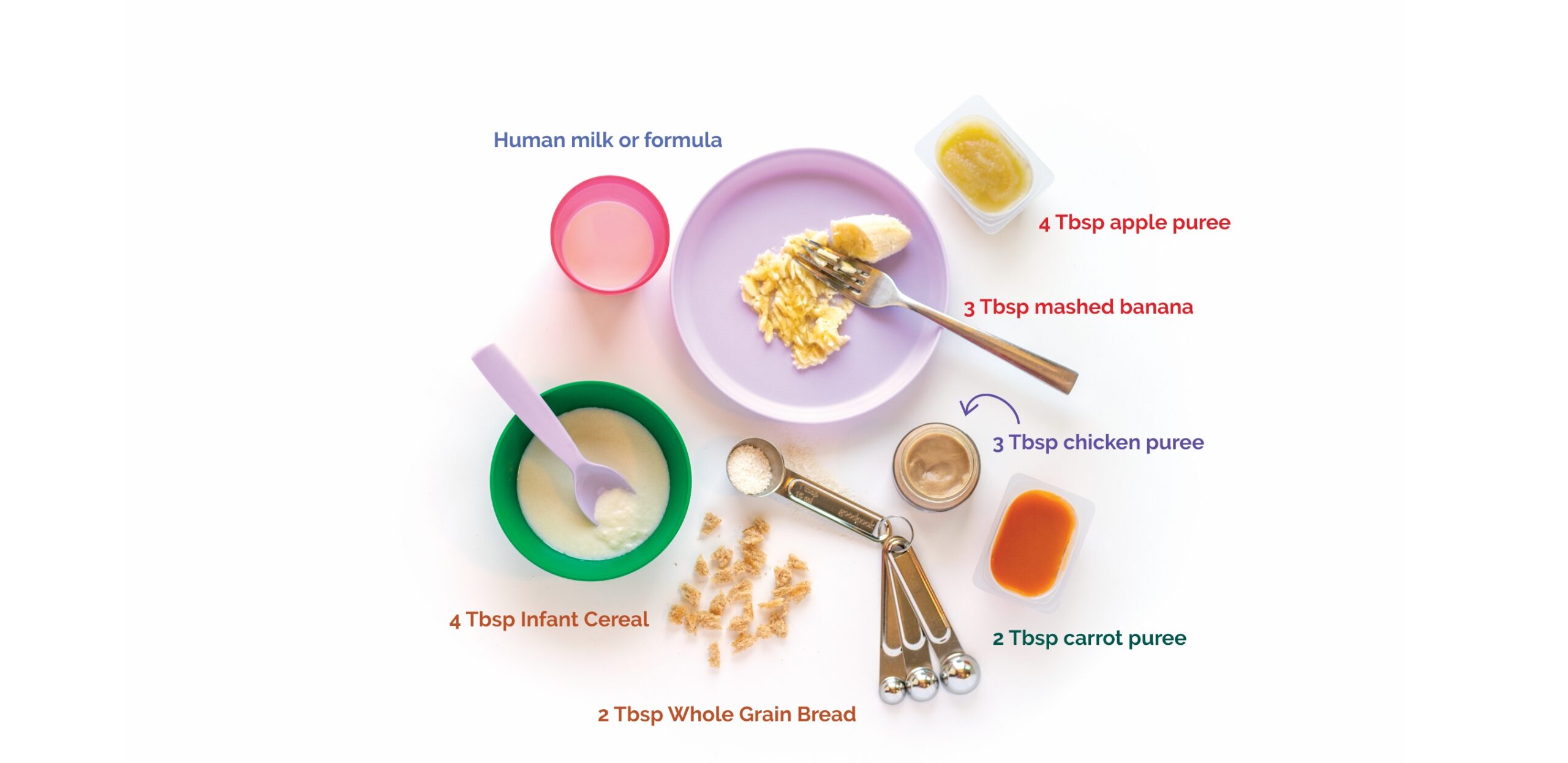
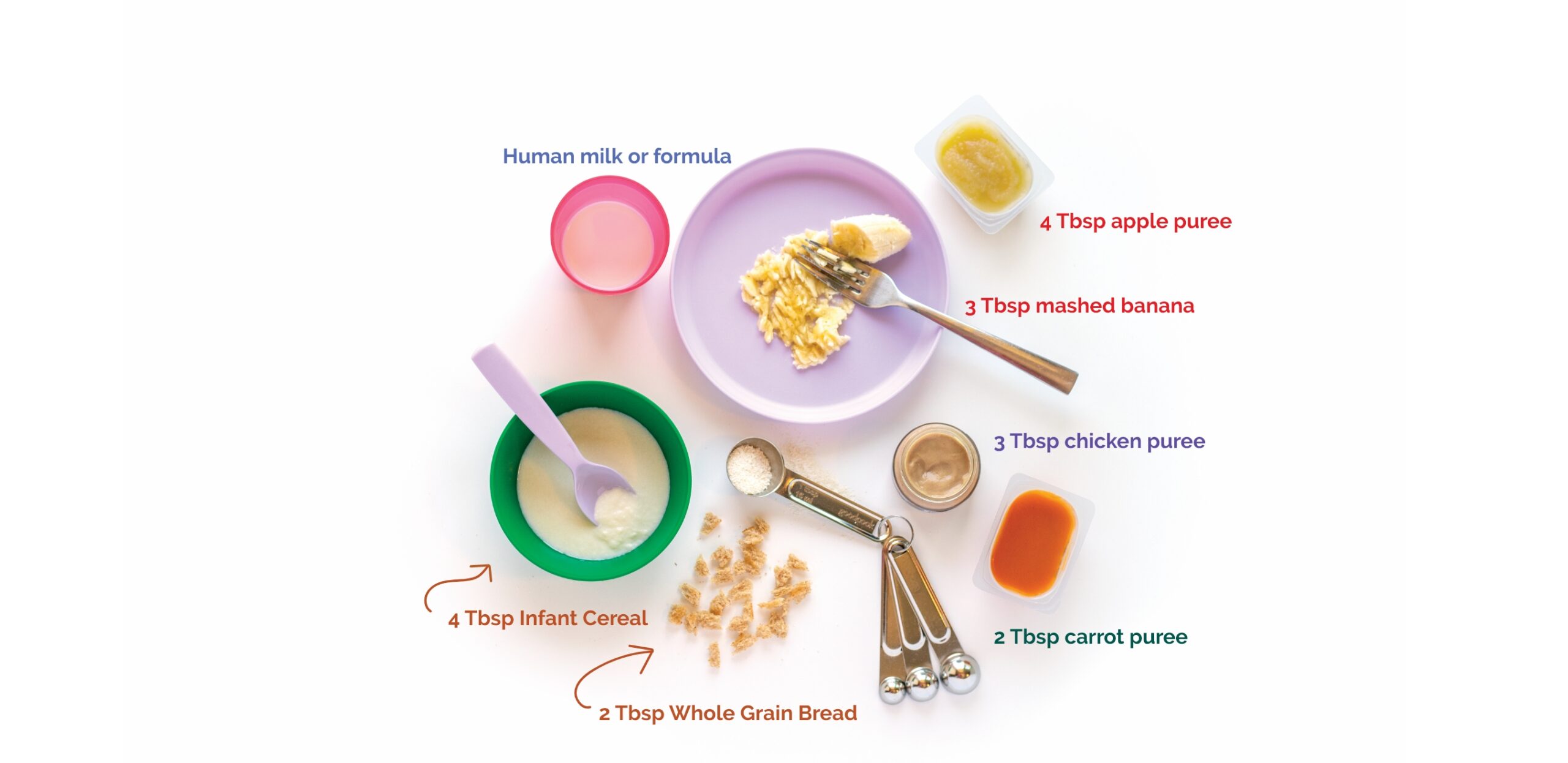
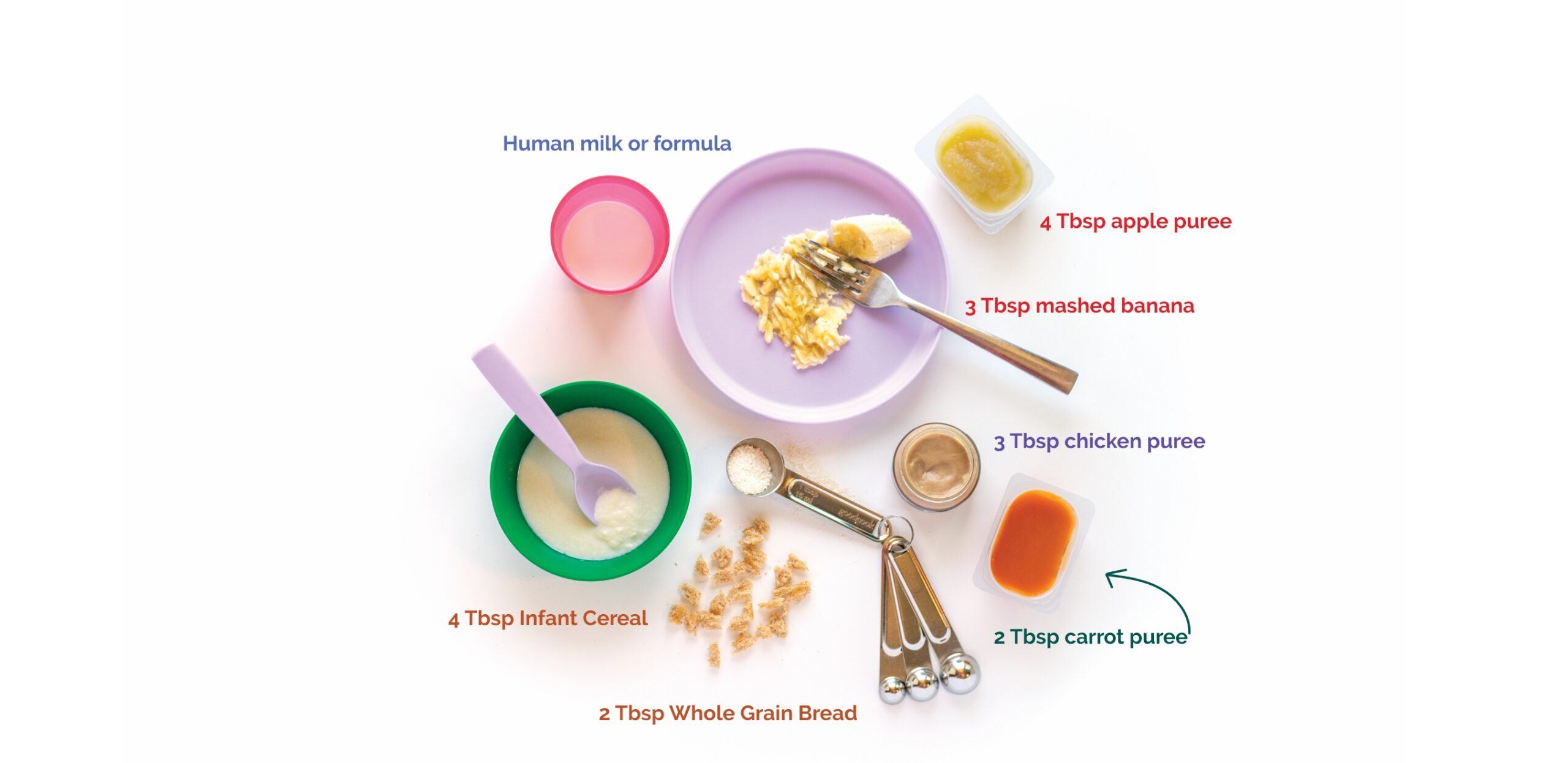
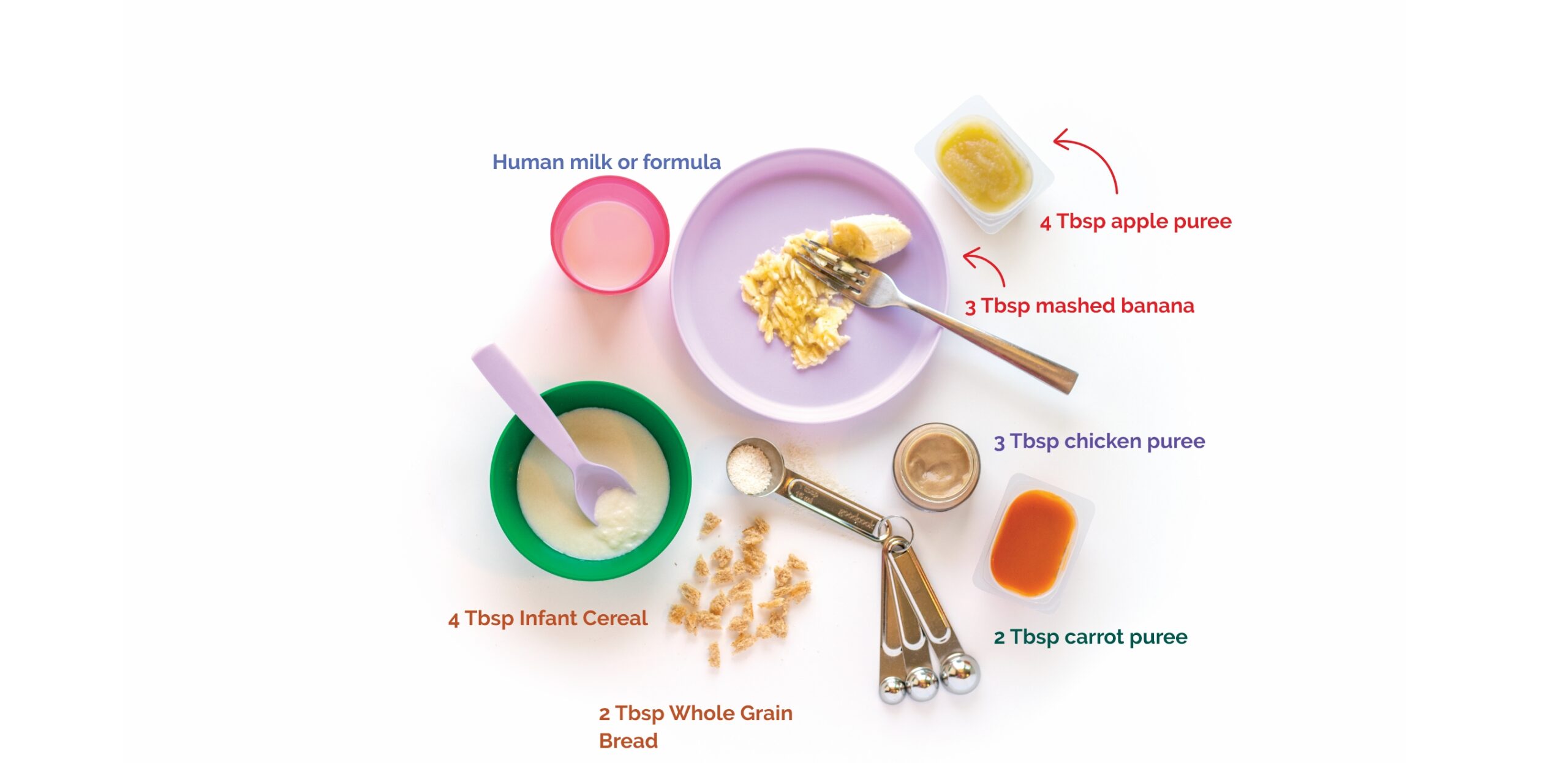
    Use breast milk or formula to prepare 2-4 Tbsp. iron-fortified infant cereal. Offer twice per day. 2-4 Tbsp. of small pieces of dry bread, baby crackers, and cereal. Offer twice per day.
    Grains
    Vegetables
    4-8 Tbsp. per day. Cooked, pureed, mashed vegetables.
    Vegetables
    Fruits
    2-4 Tbsp. per day. Cooked, pureed, mashed fruits. Applesauce, pureed peaches, or mashed banana.
    Fruits
    Proteins
    2-4 Tbsp. per day. Plain strained, mashed, or pureed meats, poultry, eggs, fish, or legumes. May add smooth whole milk yogurt. Thinned, smooth peanut or nut butter.
    Proteins

    Feeding a 10-12 Month Old

    Breast milk is the most important source of nutrition for your baby, even after you start offering solid foods.

    Breast Milk
    Infant Formula
    Breast Milk

    Continue to nurse on-demand, 3 or more times per day.

    Infant Formula

    16-24 oz. per day. Offer in a cup.

    Grains
    Vegetables
    Fruits
    Proteins
    Grains
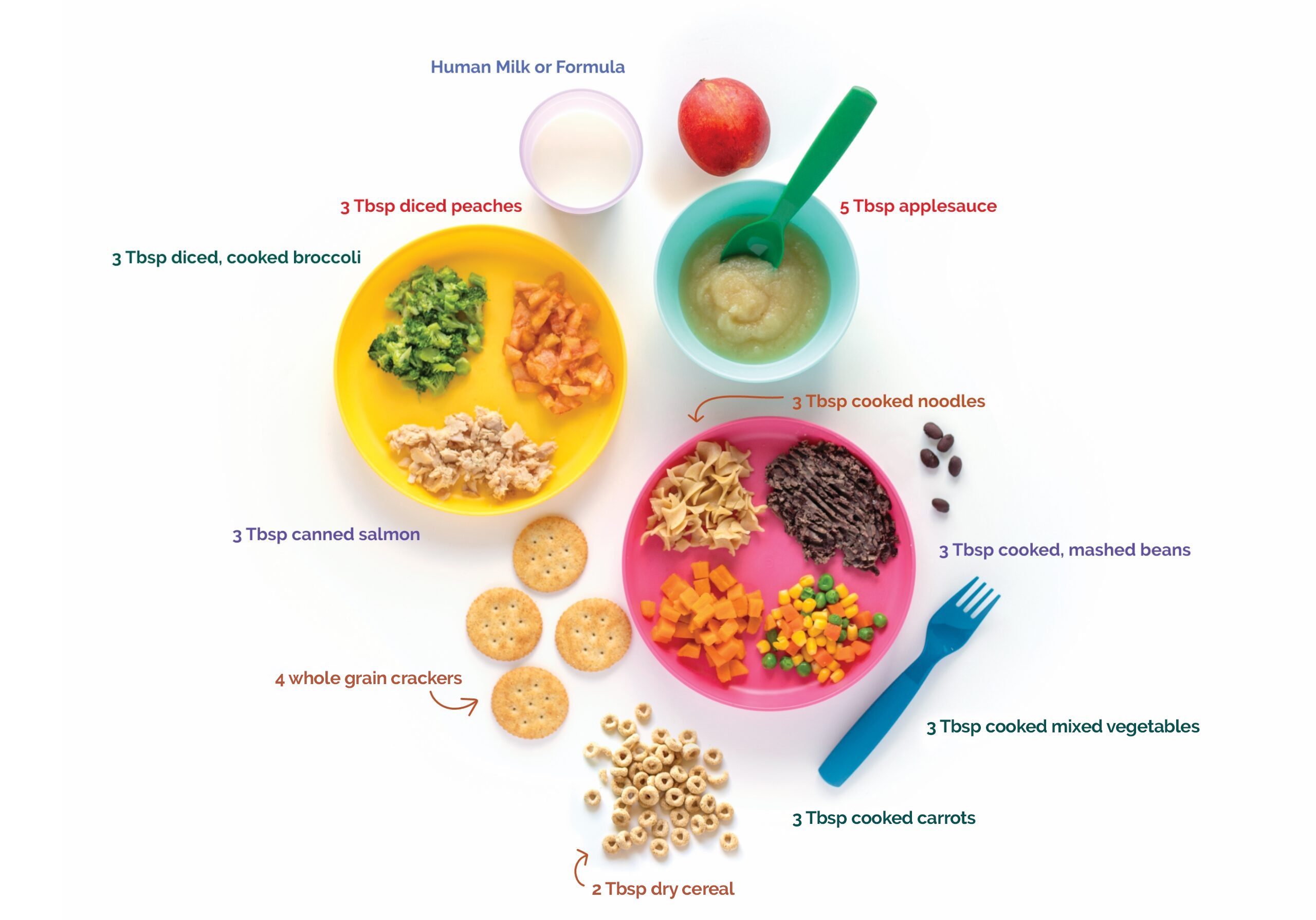
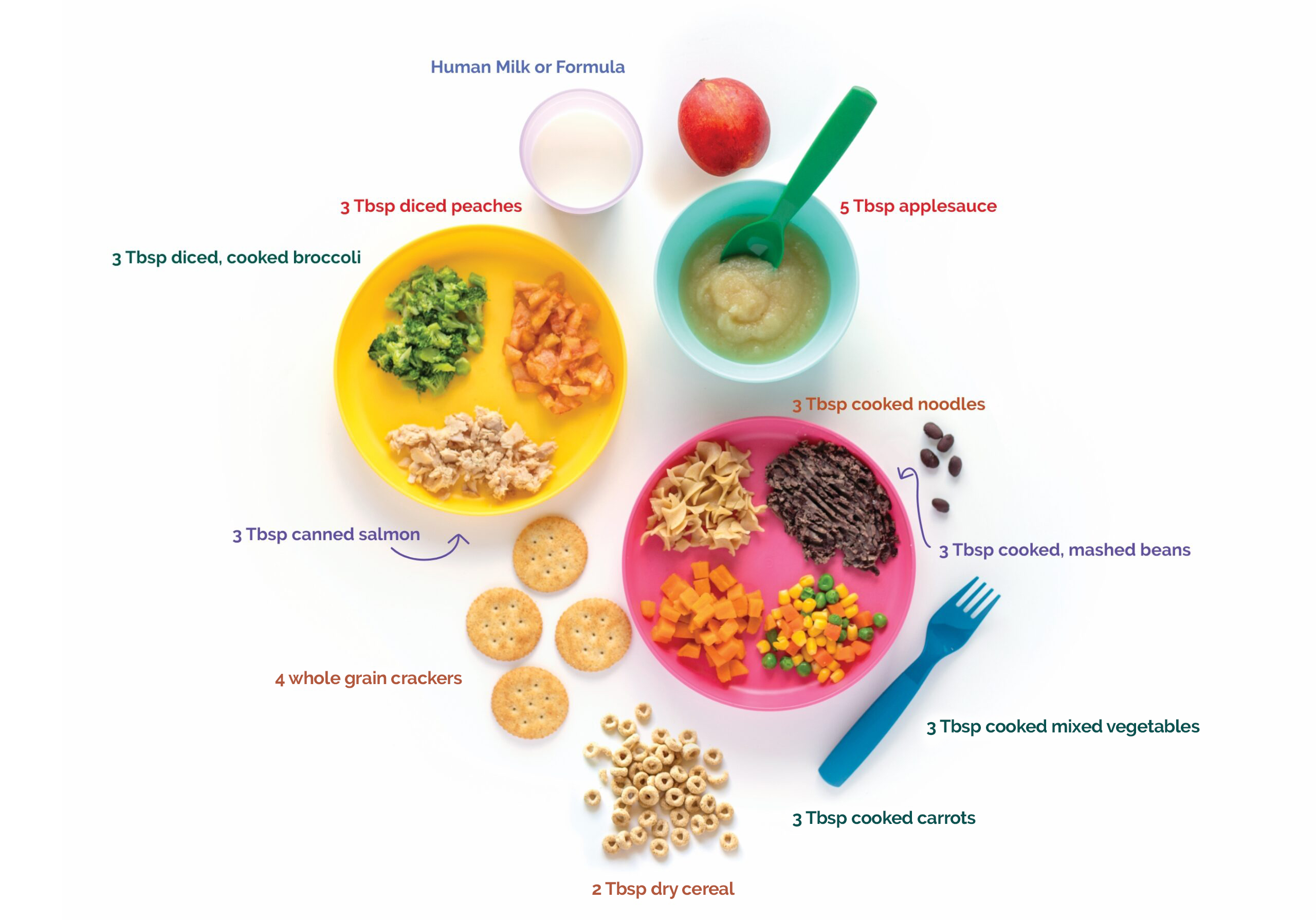
    4-8 Tbsp. per day. WIC approved infant cereals. Dry toast, crackers, bread, bagels, rolls, or plain muffins. Cooked rice and noodles.
    10-12 Month Grains
    Vegetables
    3-4 Tbsp. per day. Cooked bite-size vegetable pieces.
    10-12 Month Vegetables
    Fruits
    3-4 Tbsp. per day. Fresh fruits, peeled, and in bite-size portions.
    10-12 Month Fruits
    Proteins
    2-4 Tbsp. per day. Finely ground, chopped, or diced meats, poultry, eggs, fish, or cooked mashed beans. Thinned, smooth peanut butter.
    10-12 Month Proteins

    Feeding a 8-9 Month Old

    Feed solids with a spoon. Never put cereal in a bottle.

    Breast Milk
    Infant Formula
    Breast Milk

    Continue nursing on-demand, at least 4 times in 24 hours.

    If your baby seems less interested in nursing after you introduce solids, try nursing before you offer solids.

    Offer breast milk in a cup.

    Infant Formula

    24-32 oz. per day.

    Offer formula in a cup.

    Grains
    Vegetables
    Fruits
    Proteins
    Grains

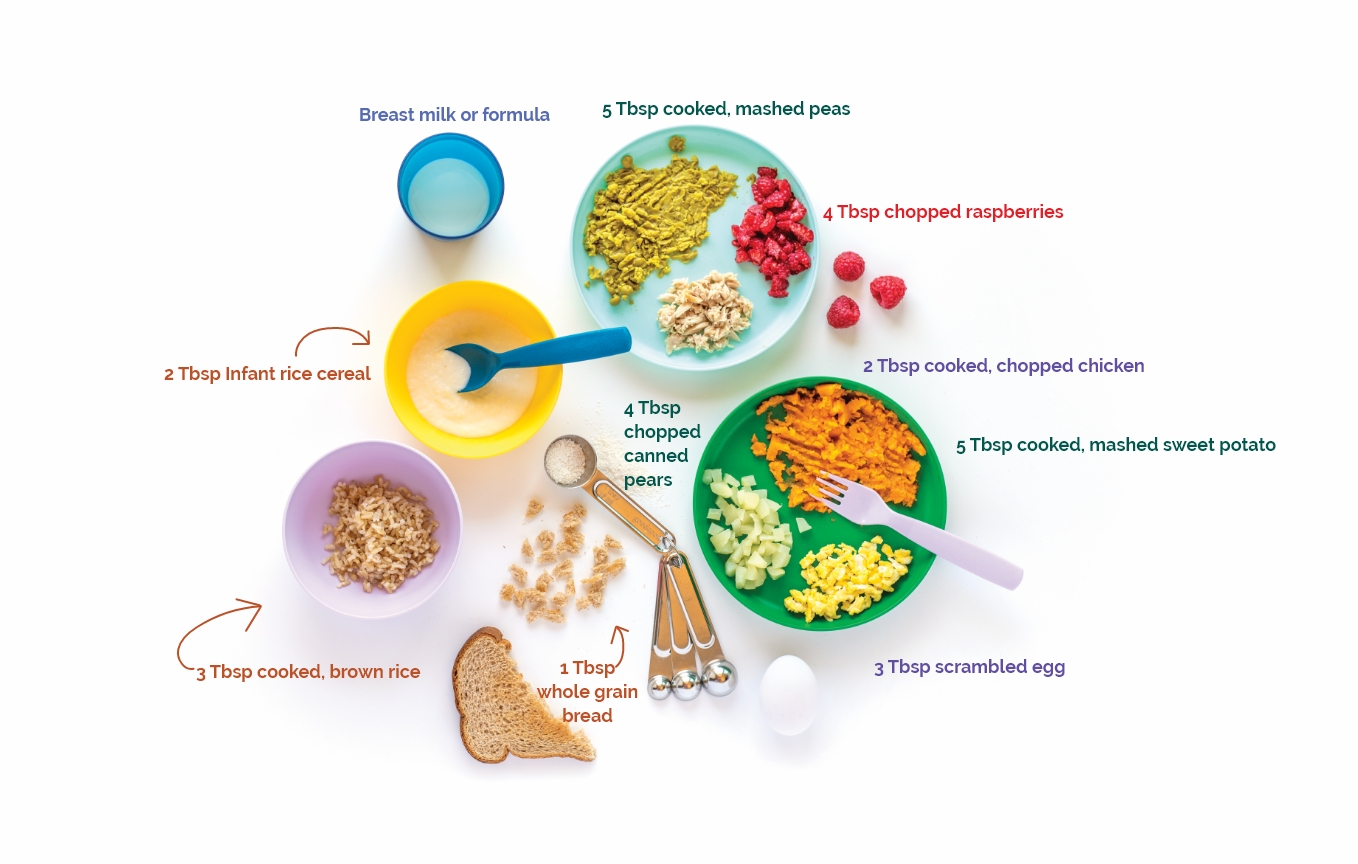
    4-8 Tbsp. per day.

    Plain iron-fortified infant cereals.

    Plain rice or pasta.

    Baby crackers, small pieces of bread, or soft tortillas.

    8-9 Month Grains
    Vegetables

    8-12 Tbsp. per day.

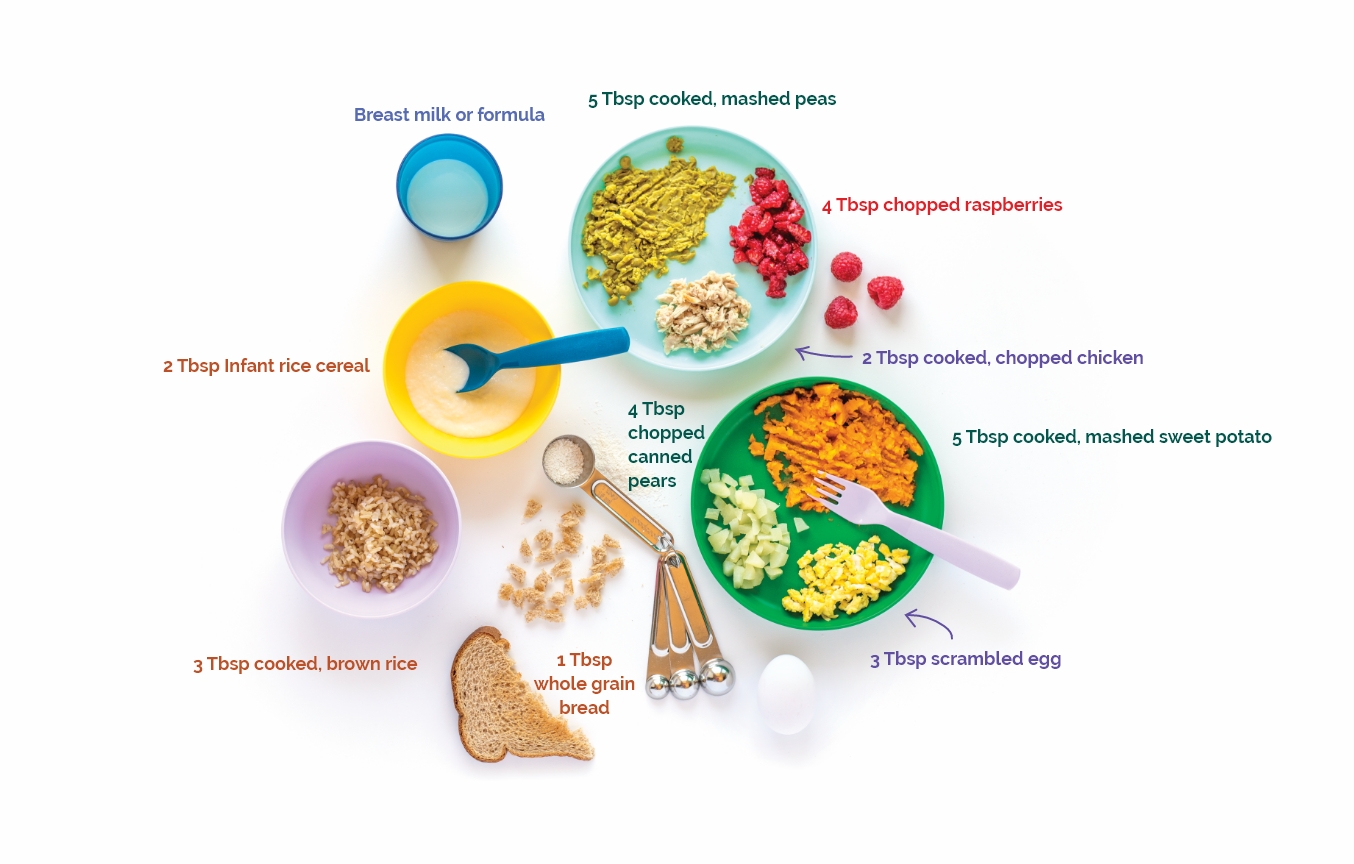
    Plain cooked vegetables, mashed with a fork.

    8-9 Month Vegetables
    Fruits

    8-12 Tbsp. per day.

    Peeled soft fruit in bite-size pieces.

    Unsweetened canned fruit.

    8-9 Month Fruits
    Proteins

    4-8 Tbsp. per day.

    Finely ground, chopped, or diced meats, poultry, eggs, fish, or cooked mashed beans.

    Cottage cheese or mild cheese.

    Thinned, smooth peanut or nut butter.

    8-9 Month Proteins
    I'm Hungry
    I'm Hungry

    Tips

    Mom new born home

    Breast milk and formula feeding:

    Around 2-3 weeks, 6 weeks, 3 months, and 6 months of age, babies may experience a growth spurt when they feed more often.

    As they grow babies can hold more milk, so feedings may become further apart and take less time.

    To prevent choking, always hold your baby when feeding. Never prop up a bottle to feed.

    Start offering whole milk when your baby is one year old.

    The American Academy of Pediatrics recommends exclusive breastfeeding for the first six months and that breastfeeding continue for at least 12 months and beyond.

    feeding solid foods

    Feeding solid foods:

    Wait to offer solid foods until your baby:

    • Can sit up and hold up their own head.
    • Opens their mouth when they see food.
    • Can close their lips around a spoon.

    To prevent choking, always hold your baby when feeding. Never prop up a bottle to feed.

    Try one new food at a time. Wait 5 days before trying another new food to watch for allergies. Food allergies may include wheezing, rash, or diarrhea.

    Introduce peanut butter around 6 months. Mix one teaspoon of peanut butter with breast milk or formula. Make it thin and easy to swallow. Use a spoon to offer a taste of the thinned product. Watch your baby for any reaction for the next 2 hours.

    Babies under one year should NOT have honey due to the risk of botulism. Also, babies should not have foods that can cause choking like nuts or whole grapes.

    All babies are different. Talk with WIC or your baby’s healthcare provider about your baby’s needs.

    Feeding Cues

    I'm Hungry
    I'm Full
    I'm Hungry
    • Stirring
      Stirring
    • Mouth opening
      Mouth opening
    • Turning head seeking/rooting
      Turning head seeking/rooting
    I'm Full
    • Releases or falls off
      Releases or “falls off”
    • Turns away
      Turns away
    • Relaxes and opens fists
      Relaxes and opens fists

    Feeding a 4-5 Month Old

    Before teeth come in, wipe gums with a soft, clean wash cloth after each feeding, especially before bed.

    Breast Milk
    Infant Formula
    Breast Milk

    Nurse your baby on-demand, at least 7-9 times in 24 hours.

    When your baby starts teething, they may want to nurse more often.

    Infant Formula

    25-45 oz in 24 hours.

    Your baby needs about 4-6 oz of iron-fortified formula every 3-4 hours.

    Your baby may start to feed on a schedule. Instead of focusing on fixed amounts, let your baby tell you when they have had enough.

    I'm Hungry
    I'm Hungry

    Feeding a 0-3 Month Old

    Newborns have tiny tummies and need to be fed often. In the first few weeks, you may need to wake your baby to feed if they sleep longer than 4 hours.

    Growth Spurts

    Many babies are fussy during a growth spurt and will want to nurse longer and more often. This is called cluster feeding. This is your baby’s way of helping you increase your milk supply so that you can keep up with their needs. Remember, the more your baby nurses, the more milk your body makes.

    Growth spurts can happen at any time, and every baby is different.

    They often happen at these ages:

    two-three-weeks

    2 to 3 Weeks

    6 Weeks

    three-months

    3 Months

    six-months

    6 Months

    Breast Milk
    Infant Formula
    Breast Milk

    Breastfeed 8-12 times in 24 hours to help your newborn stay healthy.

    Nurse on-demand and when your newborn shows signs of hunger, such as sucking on hands or smacking lips.

    Infant Formula

    In the first few days, newborns need 2-3 oz. of iron-fortified infant formula every 3-4 hours.

    By the end of the first month, your newborn needs about 4 oz. every 4 hours.

    Feed on-demand and when your newborn shows signs of hunger.

    What foods can I get?

    Authorized Food List
    Authorized Food List

    Where can I shop?