Skip to Content Skip to Footer
Delaware Wic Site Logo
  • Bay tete
  • Edikasyon sou nitrisyon
  • Vle Aprann Plis?
  • Kreyòl
    • English
    • Español

Pozisyon Kenbe nan Bay Tete

  • Lakay
  • Bay tete
  • Ki Jan Yo Bay Tete
  • Aprann Bay Tete
  • Pozisyon Kenbe Nan Bay Tete

Pozisyon Kenbe nan Bay Tete

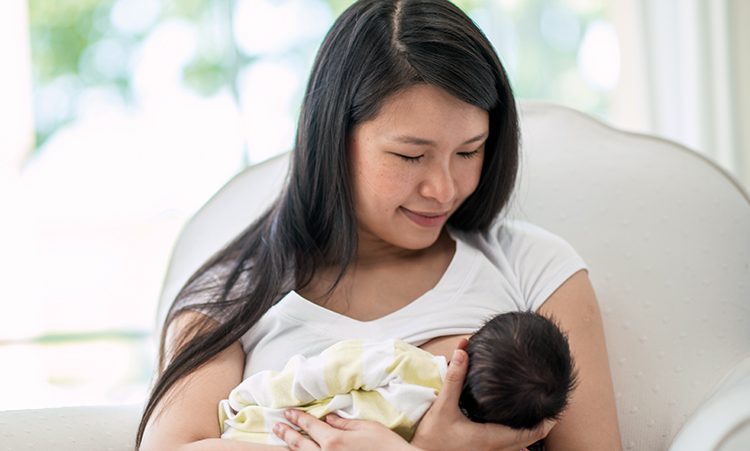
Gen anpil fason pou w kenbe tibebe w la pandan w ap bay tete. Jwenn sa ki pi byen fonksyone pou ou ak tibebe w la se sa ki pi enpòtan. Klike sou foto anba a pou aprann plis sou chak pozisyon pou kenbe nan bay tete.

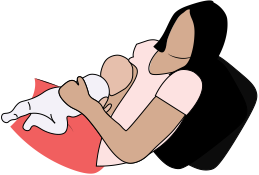
laid-back

POZISYON
KAGE

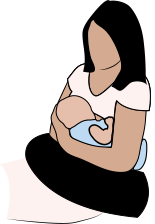
cross-cradle-hold

POZISYON TRANSVÈSAL

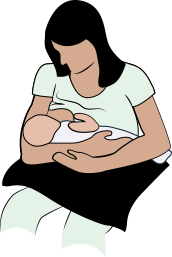
cradle-hold-icon

POZISYON BÈSO

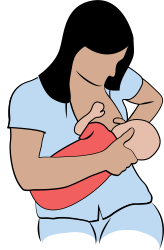
football-hold

POZISYON ANBREYAJ OSWA “FOUTBÒL AMERIKEN”

side-lying-hold

POZISYON KOUCHE SOU KOTE

Sonje

  • Pi bon pozisyon pou bay tete se sa ou santi ki pi bon pou ou ak tibebe w la - epi ede w gen yon priz.
  • Sa ki fonksyone byen pou yon alètman ka pa fonksyone byen pou pwochen an. Eseye diferan pozisyon kenbe jiskaske ou konfòtab.
  • Itilize zòrye anba bra, koud, kou oswa do w pou ba w plis konfò ak sipò.
  • Toujou leve tibebe w la jis nan wotè pwent tete w olye pou w bese sou tibebe w la. Sa ap rann bay tete a pi konfòtab epi ede tibebe w la gen yon bon priz.
  • Si ou bezwen èd pou jwenn bon poziyon pou ou ak ti bebe w la, WIC kapab ede.
Delaware Wic Site Logo

Kontakte nou

Konte New Castle
Hudson: (302) 605-4066
West End: (302) 605-6653
Northeast/Claymont: (302) 605-4099
Imèl: nccwic@delaware.gov

Konte Kent
(302) 605-1833
(302) 605-4077 (Panyòl)
Imèl: kentwic@delaware.gov

Konte Sussex
(302) 605-4055
(302) 605-4077 (Panyòl)
Imèl: sussexwic@delaware.gov

Resous yo

  • Gid sou revni
  • Sipò WIC pou Alètman
  • Delaware WIC Kliyan Portal
  • Instagram
  • Facebook
  • Youtube

Imèl: dewicprogram@delaware.gov

Enstitisyon sa a se yon founisè opòtinite egalego.
Klike la a pou deklarasyon USDA ki pa diskriminasyon.

Cookie PolicyRèg sou enfòmasyon prive

© Brush Art Corporation

  • Email
  • SMS
If you are using multiple emails, separate them with commas.

    laid-back-icon

    Laid-Back Hold

    • 1. Lean back on a pillow with your baby's tummy touching yours and their head at breast level. Some moms find that sitting up nearly straight works well. Others prefer to lean back and lie almost flat.
    • 2. You can place your baby's cheek near your breast, or you may want to use one hand to hold your breast near your baby. It's up to you and what you think feels best.
    • 3. Your baby will naturally find your nipple, latch, and begin to suckle.

    This hold is useful when:

    • Your baby is placed on your chest right after birth
    • You have a strong milk let-down
    • You have large breasts
    • You and your baby are comfortable in this position
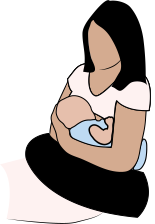
    cross-cradle-hold-icon

    Cross-Cradle Hold

    • 1. For the right breast, use your left arm to hold your baby’s head at your right breast and baby’s body toward your left side. A pillow across your lap can help support your left arm.
    • 2. Gently place your left hand behind your baby’s ears and neck, with your thumb and index finger behind each ear and your palm between baby’s shoulder blades. Turn your baby’s body toward yours so your tummies are touching.
    • 3. Hold your breast as if you are squeezing a sandwich. To protect your back, avoid leaning down to your baby. Instead, bring your baby to you.
    • 4. As your baby’s mouth opens, push gently with your left palm on baby’s head to help them latch on. Make sure you keep your fingers out of the way.
    • 5. Reverse for the left breast.

    This hold is useful when:

    • Your baby is premature
    • Your baby has a weak suck
    • Your baby needs help to stay latched
    • Your baby needs extra head support
    • You and your baby are comfortable in this position
    cradle-hold-icon

    Cradle Hold

    • 1. For the right breast, cradle your baby with your right arm. Your baby will be on their left side across your lap, facing you at nipple level.
    • 2. Your baby’s head will rest on your right forearm with your baby’s back along your inner arm and palm.
    • 3. Turn your baby’s tummy toward your tummy. Your left hand is free to support your breast, if needed. Pillows can help support your arm and elbow.
    • 4. To protect your back, avoid leaning down to your baby. Instead, bring your baby to you.
    • 5. Reverse for the left breast.

    This hold is useful when:

    • Your baby needs help latching on
    • You and your baby are comfortable in this position
    football-hold-icon

    Clutch or “Football” Hold

    • 1. For the right breast, hold your baby level, facing up, at your right side.
    • 2. Put your baby’s head near your right nipple and support their back and legs under your right arm.
    • 3. Hold the base of your baby’s head with your right palm. A pillow underneath your right arm can help support your baby’s weight.
    • 4. To protect your back, avoid leaning down to your baby. Bring baby to you instead.
    • 5. Reverse for the left breast.

    This hold is useful when:

    • You had a C-section
    • You have large breasts
    • You have flat or inverted nipples
    • You have a strong milk let-down
    • You are breastfeeding twins
    • Your baby likes to feed in an upright position
    • Your baby has reflux
    • You and your baby are comfortable in this position
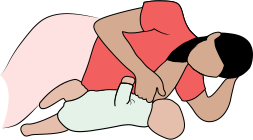
    side-lying-hold-icon

    Side-Lying Hold

    • 1. For the right breast, lie on your right side with your baby facing you.
    • 2. Pull your baby close. Your baby’s mouth should be level with your nipple.
    • 3. In this position, you can cradle your baby’s back with your left arm and support yourself with your right arm and/or pillows.
    • 4. Keep loose clothing and bedding away from your baby.
    • 5. Reverse for the left breast.

    This hold is useful when:

    • You had a C-section
    • You want to rest while baby feeds
    • You are breastfeeding in the middle of the night
    • You and your baby are comfortable in this position
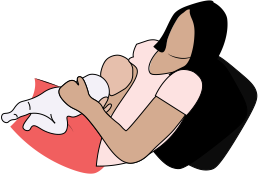
    laid-back

    POZISYON KAGE

    • 1. Panche pa dèyè sou yon zòrye kote vant tibebe w la touche pa w epi tèt li nan nivo bra a. Gen kèk manman ki twouve chita prèske drèt fonksyone byen. Lòt yo prefere panche dèyè epi kouche prèske plat.
    • 2. Ou ka mete machwè tibebe w la sou tete w oswa ou ka vle itilize yon men pou kenbe tete w toupre tibebe w la. Sa depann de ou ak sa ou santi ki mye a.
    • 3. Tibebe w la natirèlman ap jwenn pwent tete w epi kòmane souse.

    Pozisyon kenbe sa itil lè:

    • Mete tibebe w la sou pwatrin ou touswit apre li fin fèt
    • Ou gen bonkou lèt k ap desann
    • Ou gen gwo tete
    • Ou menm ak tibebe w la konfòtab nan pozisyon sa
    cross-cradle-hold

    POZISYON TRANSVÈSAL

    • 1. Pou tete dwat la, itilize bra goch ou pou kenbe tèt tibebe w la nan tete dwat ou ak kò bebe a nan direkyon bò gòch ou. Yon zòrye sou janm ou ka ede sipòte bra gòch ou.
    • 2. Mete men gòch ou dousman dèyè zòrèy ak kou tibebe w la, kote pous ak endèks ou dèyè chak zòrèy epi pla men ou ant omoplat tibebe a. Vire kò tibebe a nan sans kò w pou vant ou yo ka ap touche.
    • 3. Kenbe tete ou tankou ou t ap peze yon sandwich. Pou pwoteje do w, evite bese nan direksyon tibebe w la. Olye de sa, rale tibebe w la sou ou.
    • 4. Pandan bouch tibebe w la ouvri, pouse dousman avèk pla men gòch ou sou tèt tibebe a pou ede li pran tete a. Asire ou kenbe dwèt ou yo lwen.
    • 5. Chanje pou tete gòch la.

    Pozisyon sa itil lè:

    • Tibebe w la prematire
    • Tibebe w la souse fèb
    • Tibebe w la bezwen èd pou li rete nan tete a
    • Tibebe a la bezwen sipò anplis pou tèt
    • Ou menm ak tibebe w la konfòtab nan pozisyon sa a
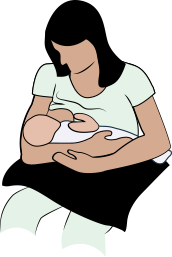
    cradle-hold-icon

    POZISYON BÈSO

    • 1. Pou tete dwat la, bèse tibebe w la avèk bra dwat ou. Tibebe w la pral sou bò gòch li sou janm ou, fas li nan nivo pwent tete a.
    • 2. Tèt tibebe w la pral repoze sou avanbra dwat ou kote do tibebe w la ap nan pati pa anndan bra ak pla men ou.
    • 3. Vire vant tibebe w la nan direksyon vant ou. Men gòch ou lib pou sipòte tete w, si nesesè. Zòrye yo kapab ede sipòte bra ak koud ou.
    • 4. Pou pwoteje do w, evite bese nan direksyon tibebe w la. Olye de sa, rale tibebe w la sou ou.
    • 5. Chanje pou tete gòch la.

    Pozisyon sa itil lè:

    • Tibebe w la bezwen èd pou li pran tete w
    • Ou menm ak tibebe w la konfòtab nan pozisyon sa
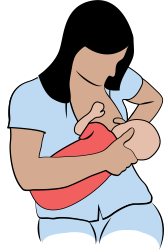
    football-hold

    POZISYON ANBREYAJ OSWA “FOUTBÒL AMERIKEN”

    • 1. Pou tete dwat la, kenbe nivo tibebe w la, fas devan sou kote dwat ou.
    • 2. Mete tèt tibebe w la toupre pwent tete w epi sipòte do li ak janm li anba bra dwat ou.
    • 3. Kenbe baz tèt tibebe w la avèk pla men dwat ou. Yon zòrye anba bra dwat ou ka ede sipòte pwa tibebe w la.
    • 4. Pou pwoteje do w, evite bese nan direksyon tibebe w la. Rale li vin jwenn ou pito.
    • 5. Chanje pou tete gòch la.

    Pozisyon sa itil lè:

    • Ou te fè sezaryèn
    • Ou gen gwo tete
    • Ou gen pwent tete plat oswa envèse
    • Ou gen gwo kantite lèt ki desann
    • W ap bay jimo tete
    • Tibebe w la renmen manje nan pozisyon vètikal
    • Tibebe w la gen refliks
    • Ou menm ak tibebe w la konfòtab nan pozisyon sa a
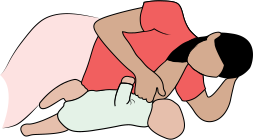
    side-lying-hold

    POZISYON KOUCHE SOU KOTE

    • 1. Pou tete dwat la, kouche sou bò dwat ou avèk tibebe w la ki ba w fas.
    • 2. Rale tibebe w la toupre w. Bouch tibebe w la ta dwe nan nivo pwent tete w.
    • 3. Nan pozisyon sa, ou ka bèse do tibebe w la avèk bra gòch epi soutni tèt ou avèk bra dwa ou ak/oswa zòrye yo.
    • 4. Kenbe gwo rad ak rad kabann yo lwen tibebe w la.
    • 5. Chanje pou tete gòch la.

    Pozisyon sa itil lè:

    • Ou te gen yon sezaryèn
    • Ou vle repoze pandan w ap bay tibebe a tete.
    • W ap bay tete nan mitan lannuit.
    • Ou menm ak tibebe w la konfòtab nan pozisyon sa

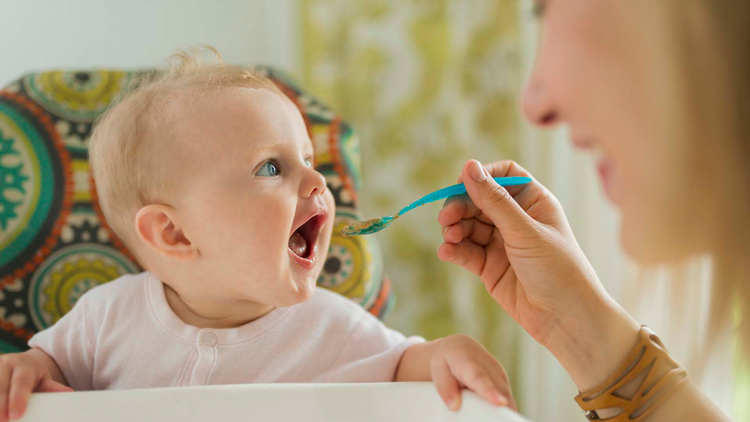
    Bay yon Tibebe 6-7 Mwa Manje

    Bay manje pire nan kiyè ak nan yon bòl, jamè nan yon bibwon. Kòmanse ak legim an premye pou kèk jou anvan ou prezante manje annapre a.

    Lèt Tete
    Lèt Tibebe
    Lèt Tete

    Kontinye bay tete sou demann, apeprè 4 jiska 6 fwa nan 24 èdtan.

    Tibebe yo ka fè fas ak yon pouse kwasans anviwon 6 mwa daj epi yo ka manje pi souvan.

    Ofri lèt tete nan yon gode.

    Lèt Tibebe

    24-32 ons chak jou nan lèt ki gen fè ladan. Ofri lèt nan yon gode.

    Grenn
    Legim
    Fwi
    Pwoteyin
    Grenn

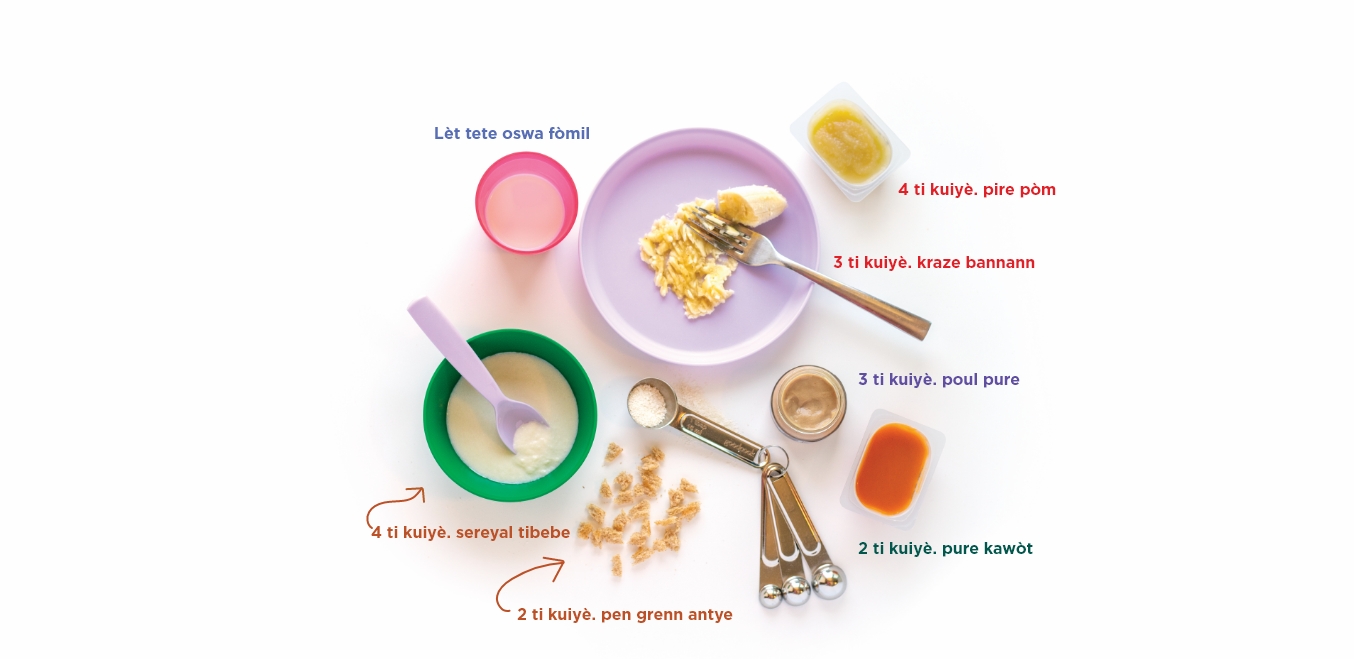
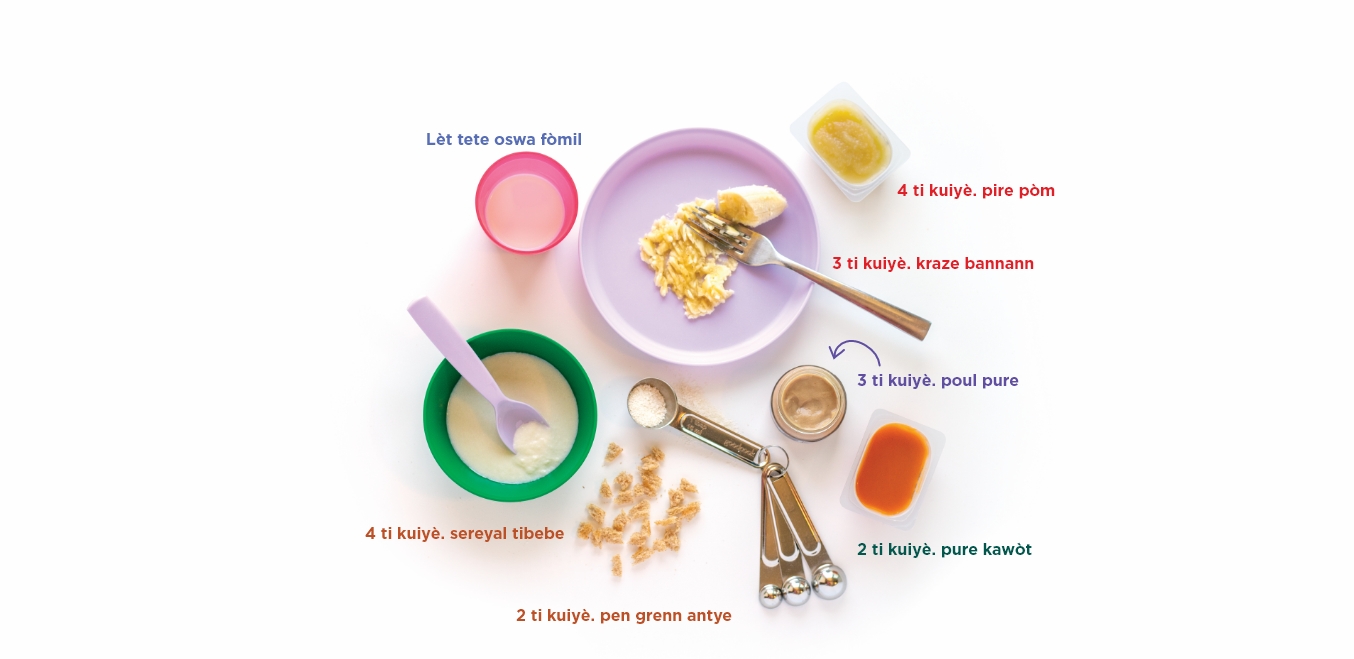
    Itilize lèt tete oswa lèt tibebe pou prepare 2-4 gwo kiyè sereyal tibebe ki gen fè ladan. Ofri de fwa pa jou.

    2-4 gwo kiyè ti moso pen sèk, ti bonbon sèl, ak sereyal. Ofri de fwa pa jou.
    Grains
    Legim

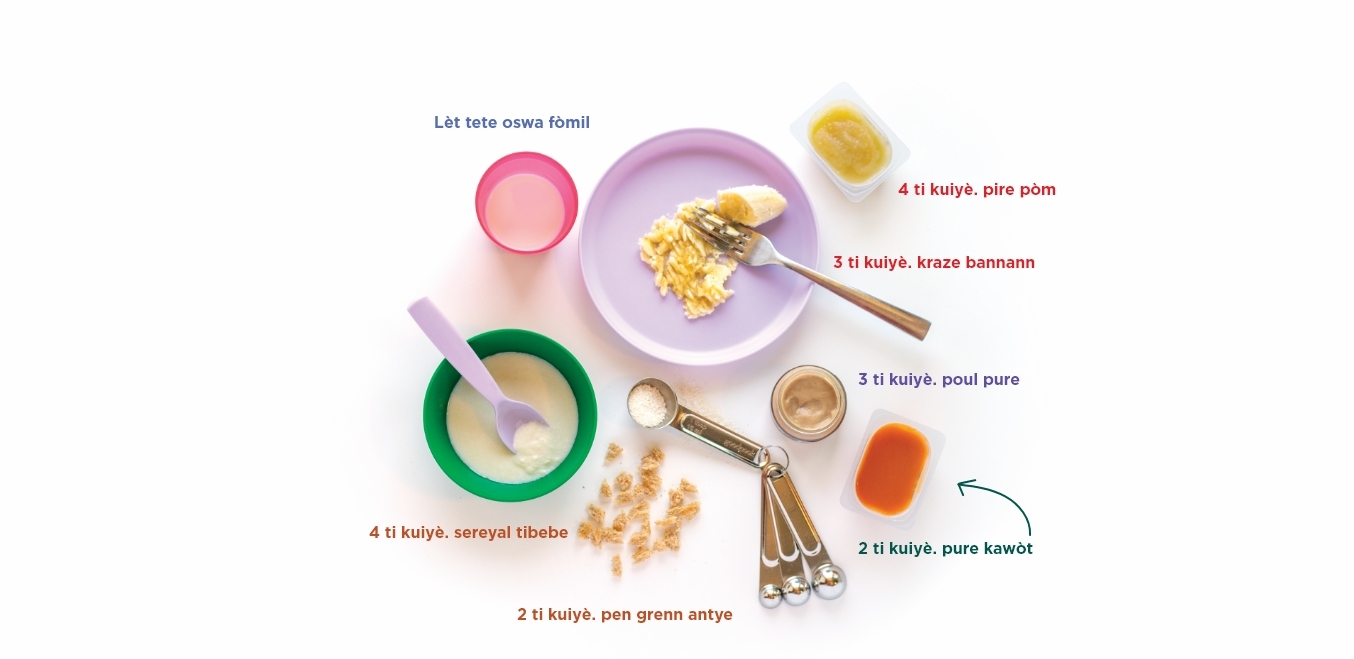
    4-8 gwo kiyè chak jou.

    Legim Kuit, pire, kraze.
    Vegetables
    Fwi

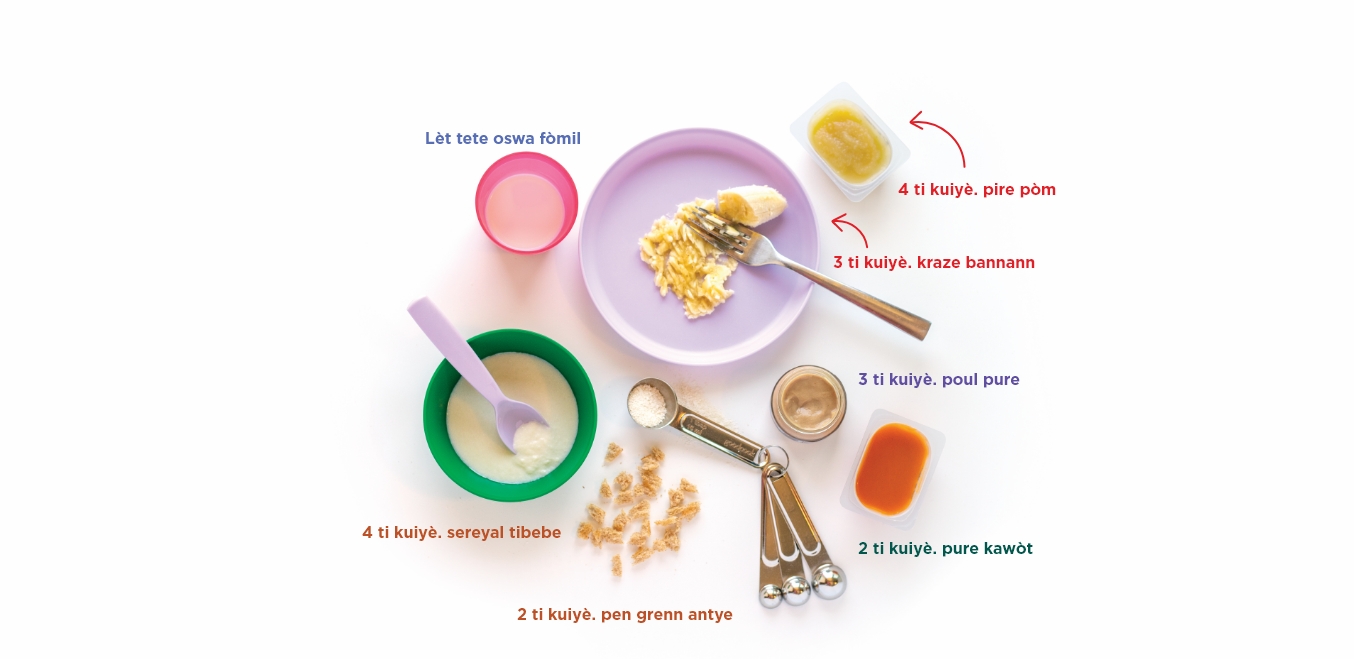
    4-8 gwo kiyè chak jou.

    Fwi Kuit, pire, kraze. Sòs pòm, pire pèch, oswa fig kraze.
    Fruits
    Pwoteyin

    2-4 gwo kiyè chak jou.

    Vyann, vyann bèt volay, ze, pwason, oswa legim an pire, kraze oswa pire.

    Ka ajoute yogout lèt antye lis.

    Pou dilye manba, sèvi ak sereyal tibebe oswa yogout lèt antye.
    Proteins

    Bay yon Tibebe 10-12 Mwa Manje

    Lèt tete se sous nitrisyon ki pi enpòtan pou tibebe w la, menm apre ou kòmanse ofri l manje solid.

    Lèt Tete
    Lèt Tibebe
    Lèt Tete
    Kontinye bay tete sou demann, 3 fwa oswa plis chak jou.
    Lèt Tibebe

    16-24 ons chak jou. Ofri nan yon gode.

    Grenn
    Legim
    Fwi
    Pwoteyin
    Grenn

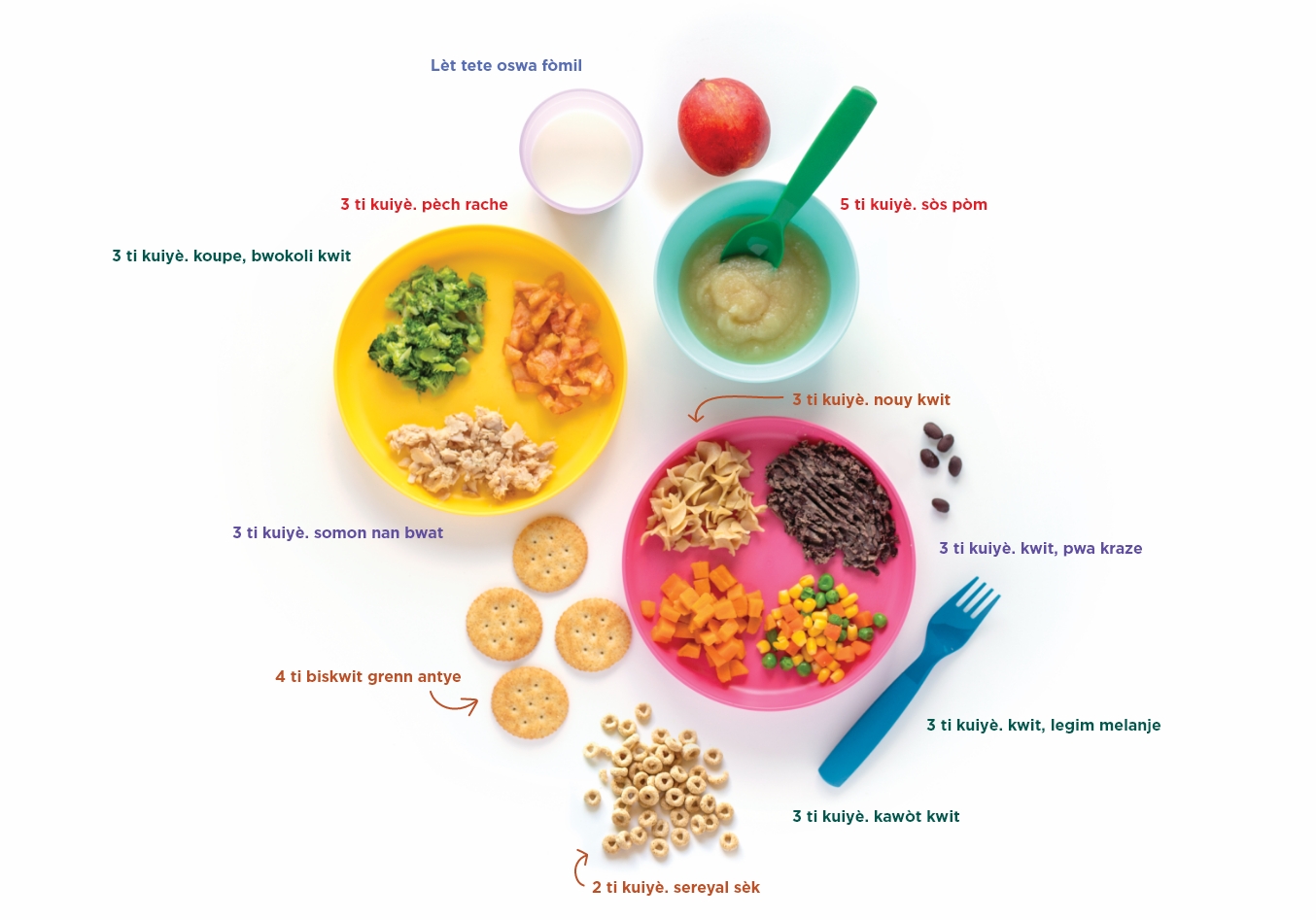
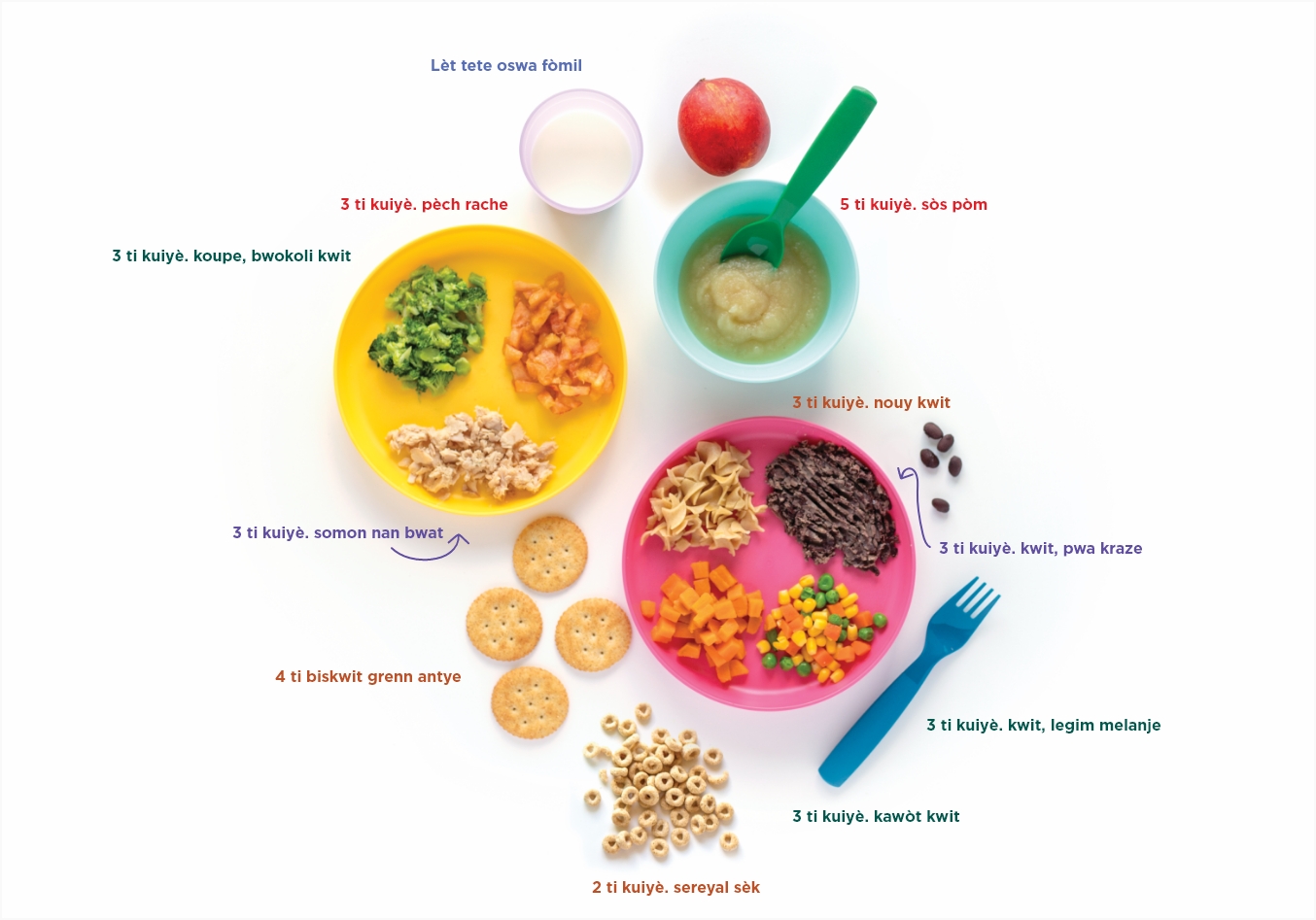
    4-8 gwo kiyè chak jou.

    Sereyal pou tibebe WIC apwouve.

    Pen griye sèk, ti biskwit, pen, bagèl, woulo, oswa ponmkèt òdinè.

    Diri ak nouy ki kuit.
    10-12 Month Grains
    Legim

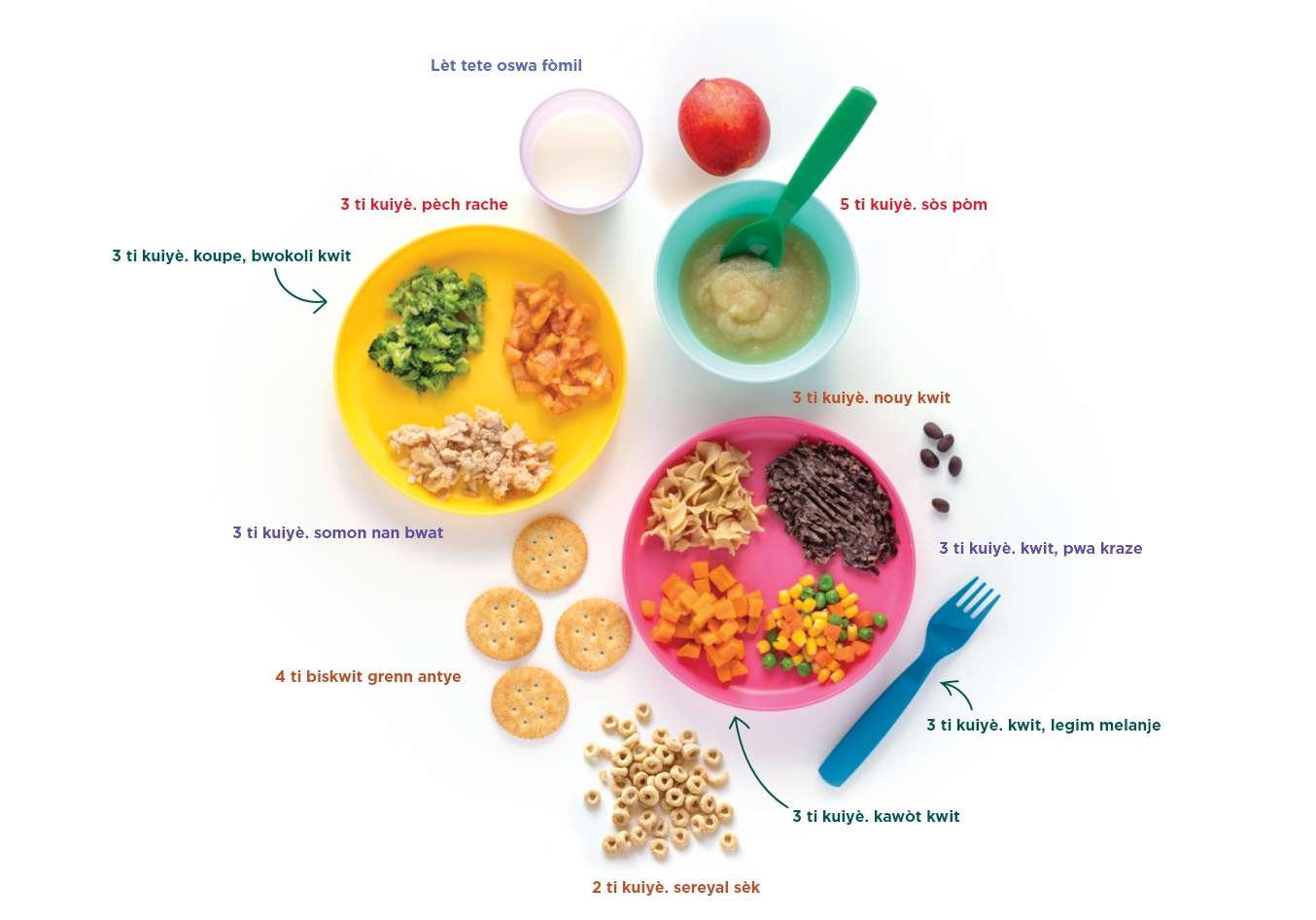
    3-4 gwo kiyè chak jou.

    Moso legim kwit gwosè yon kout dan.
    10-12 Month Vegetables
    Fwi

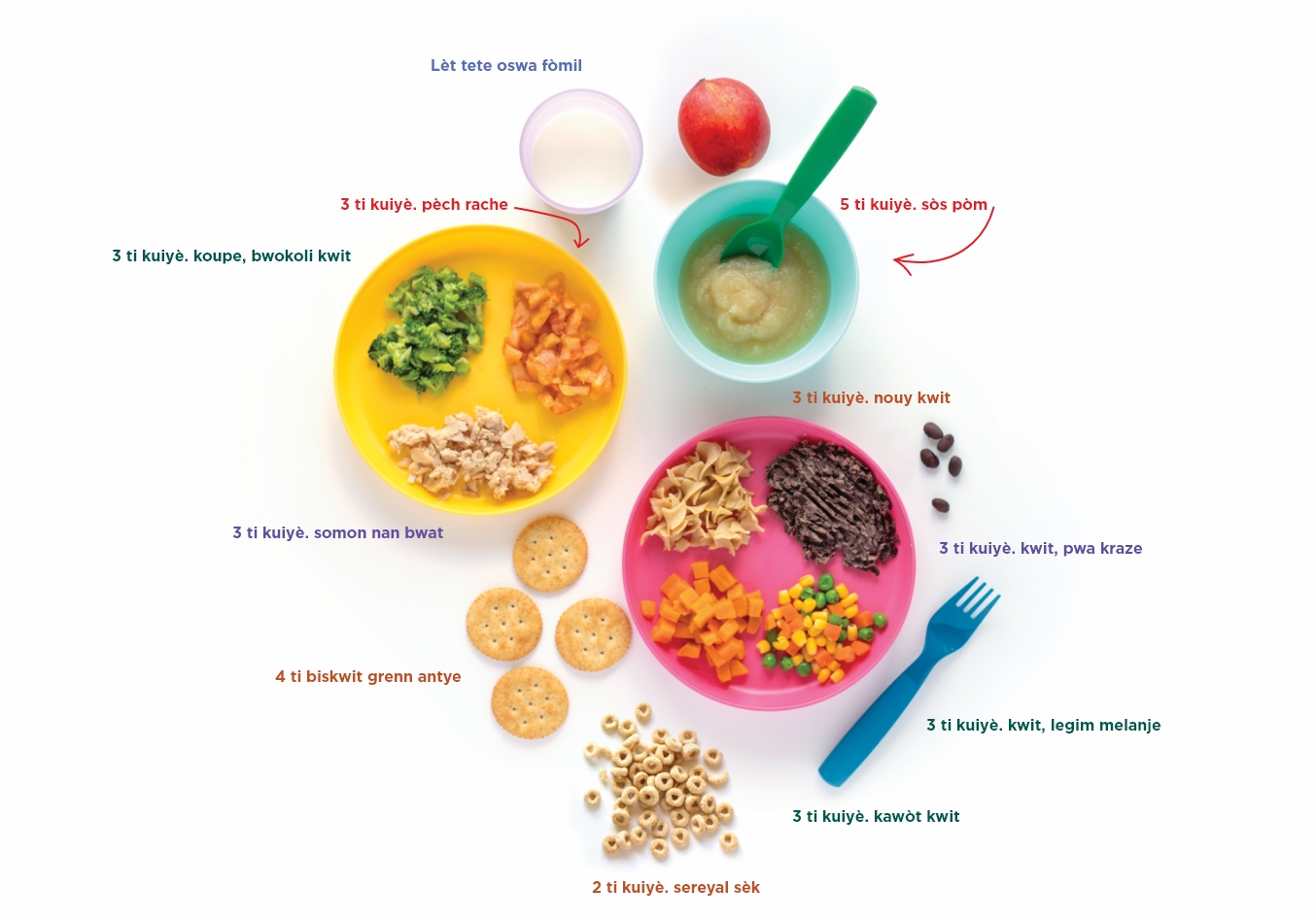
    3-4 gwo kiyè chak jou.

    Fwi fre, kale, ak nan pòsyon gwosè yon kout dan.
    10-12 Month Fruits
    Pwoteyin

    2-4 gwo kiyè chak jou.

    Vyann ki byen rache, koupe oswa vyann ki koupe an kib, bèt volay, ze, pwason, oswa pwa kraze kuit.

    Manba fen, lis.
    10-12 Month Proteins

    Bay yon Tibebe 8-9 Mwa Manje

    Bay manje ki solid yo nan kiyè. Pa janm mete sereyal nan yon bibwon.
    Lèt Tete
    Lèt Tibebe
    Lèt Tete

    Kontinye bay tete sou demann, omwen 4 fwa nan 24 èdtan.

    Si tibebe w la sanble mwens enterese nan tete apre ou fin prezante solid, eseye bay tete anvan ou ofri solid.

    Ofri lèt tete nan yon gode.

    Lèt Tibebe

    24-32 ons chak jou.

    Ofri lèt nan yon gode.

    Grenn
    Legim
    Fwi
    Pwoteyin
    Grenn

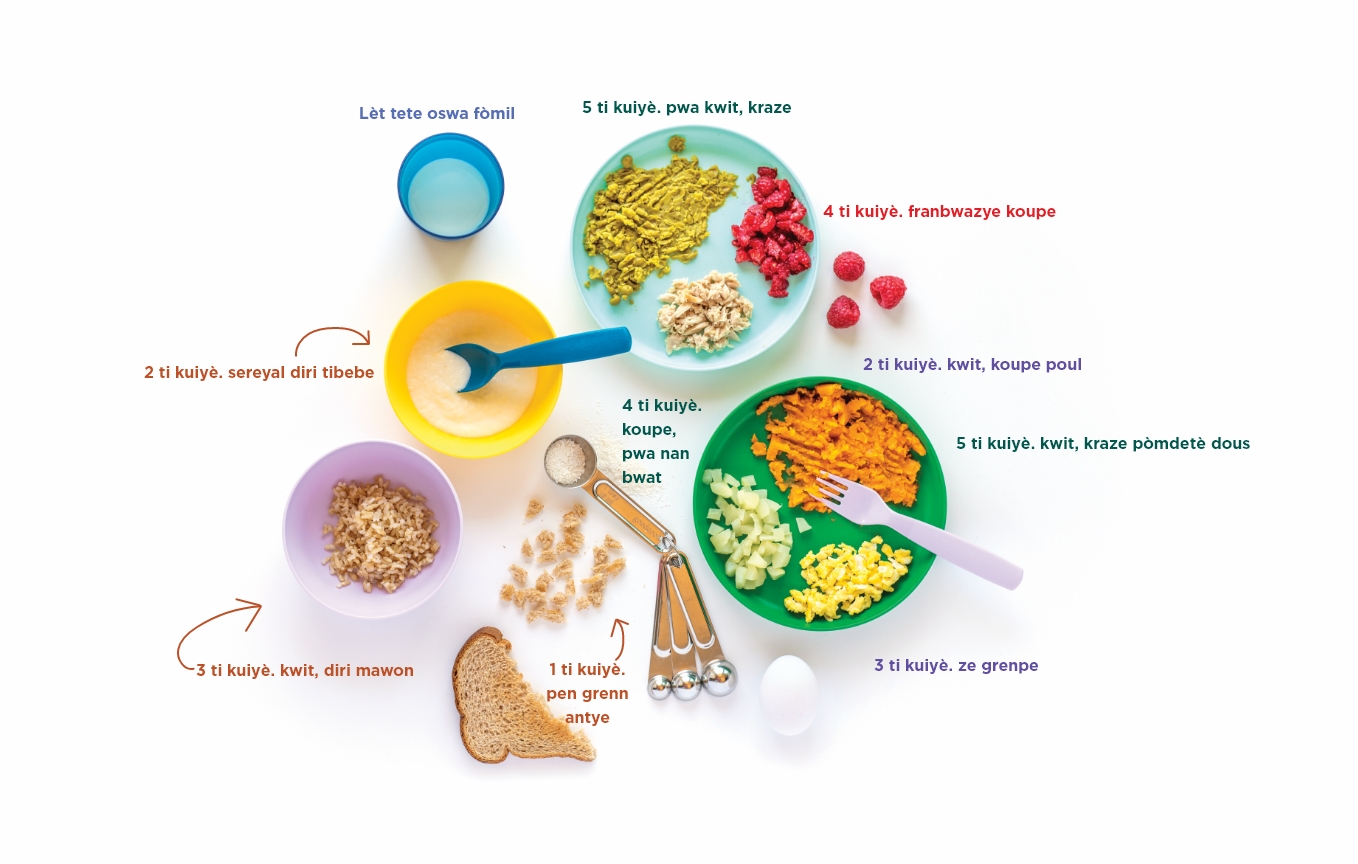
    4-8 gwo kiyè chak jou.

    Sereyal tibebe òdinè ki gen fè ladan.

    Diri oswa pat òdinè.

    Biskwit ti bebe, ti moso pen, oswa tòtiya mou.
    8-9 Month Grains
    Legim

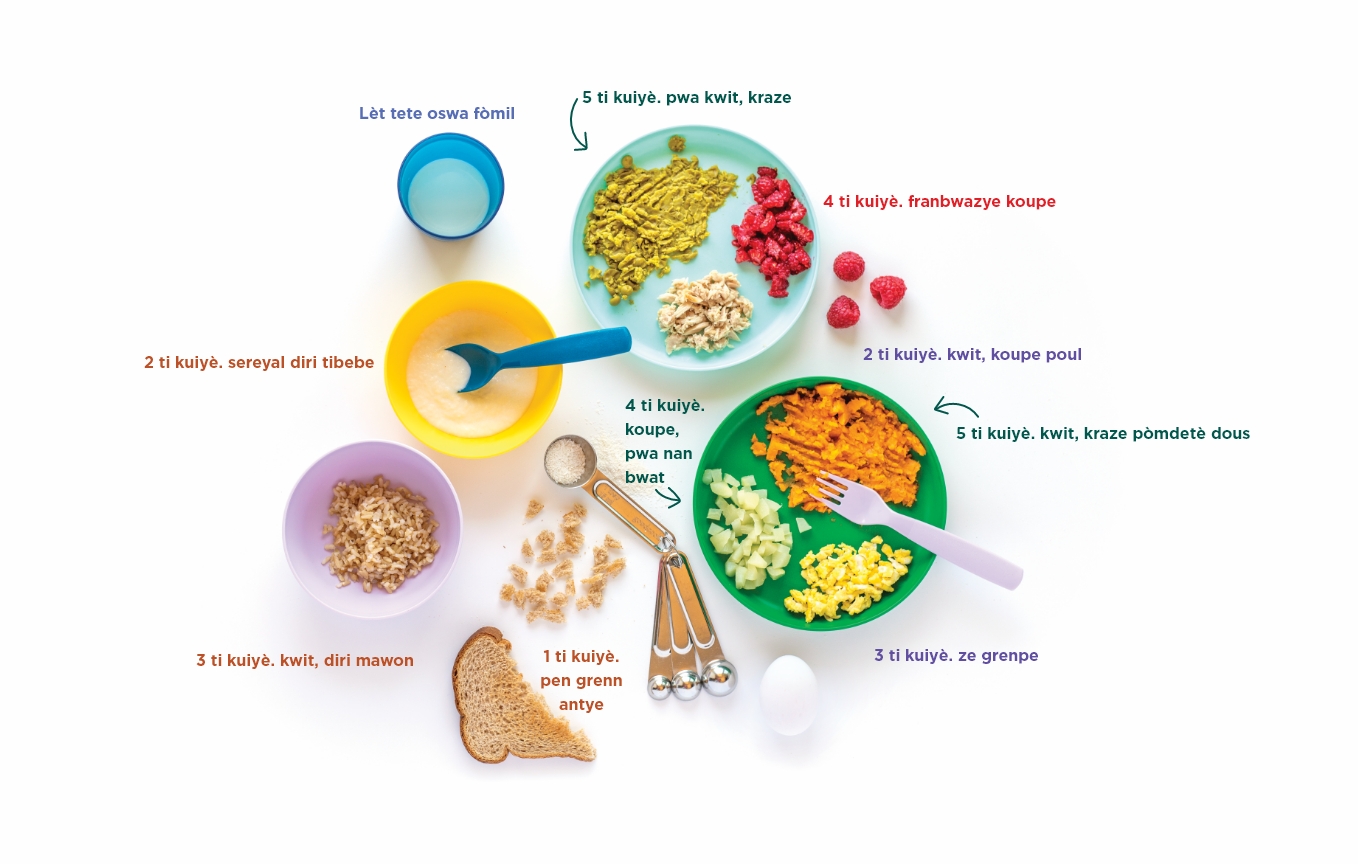
    8-12 gwo kiyè chak jou.

    Legim òdinè ki kwit, kraze ak yon fouchèt.
    8-9 Month Vegetables
    Fwi

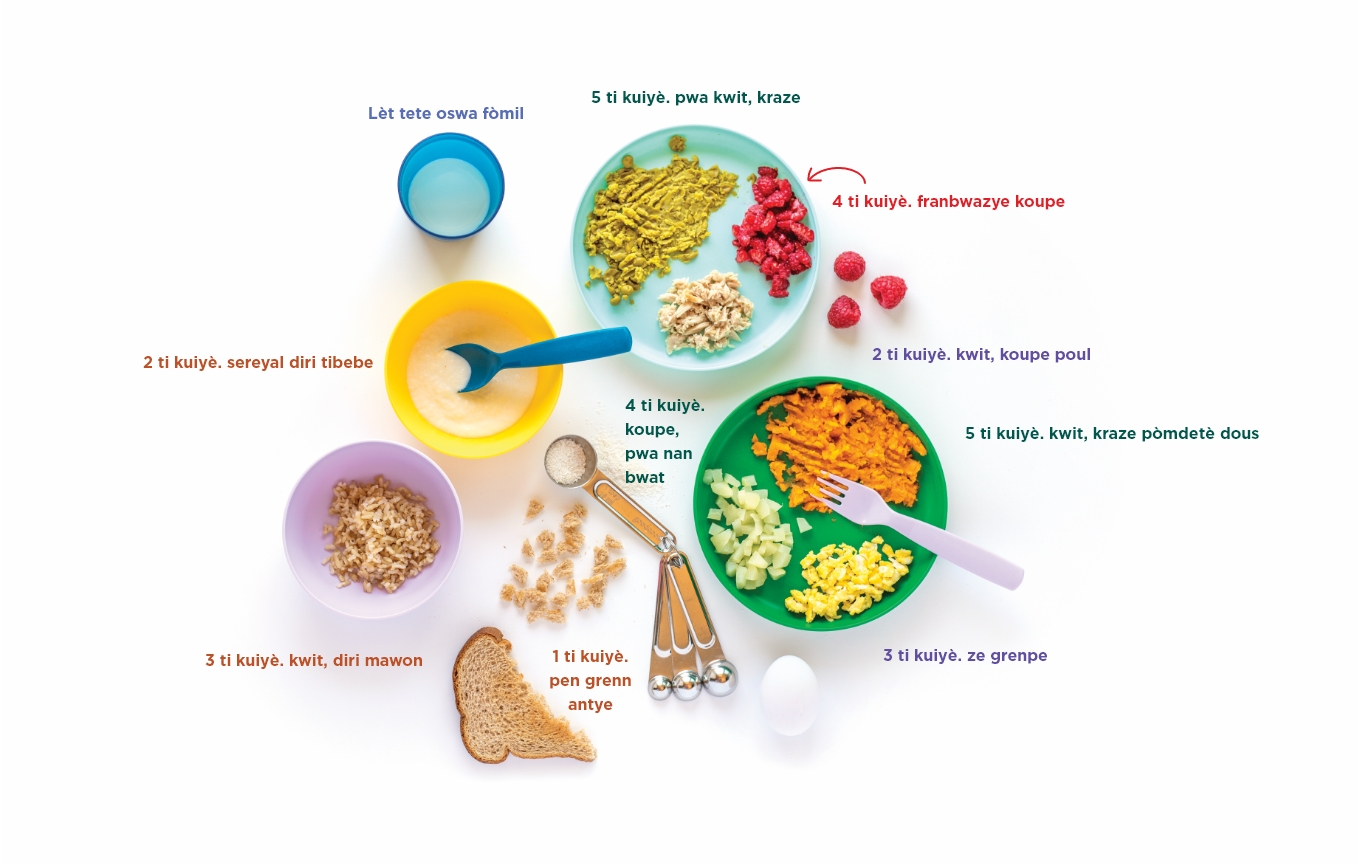
    8-12 gwo kiyè chak jou.

    Fwi mou kale an moso ki gwosè yon bouche.

    Fwi nan bwat san sik.
    8-9 Month Fruits
    Pwoteyin

    4-8 gwo kiyè chak jou.

    Vyann ki byen rache, koupe oswa vyann ki koupe an kib, bèt volay, ze, pwason, oswa pwa kraze kuit.

    Fwomaj kotaj oswa fwomaj dou.

    Manba oswa nwa fen, lis.
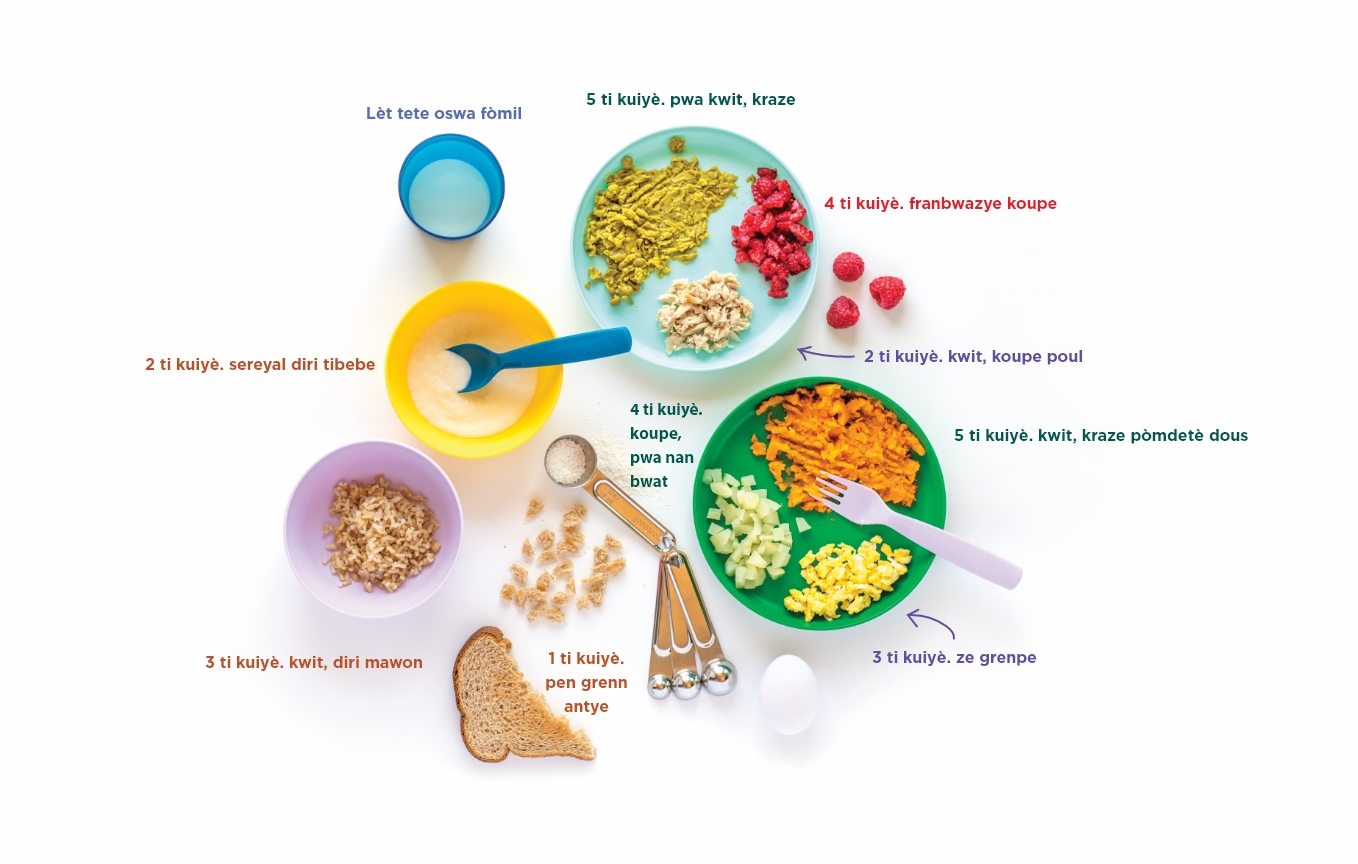
    8-9 Month Proteins
    I'm Hungry
    I'm Hungry

    Konsèy

    Mom new born home

    LÈT TETE AK LÈT TIBEBE:

    Anviwon 2-3 semèn, 6 semèn, 3 mwa, ak 6 mwa daj, ti bebe yo ka fè fas ak yon pouse kwasans lè yo manje pi souvan.

    Pandan y ap grandi ti bebe yo ka kenbe plis lèt, kidonk lè ant chak repa vin gen plis eka epi yo pran mwens tan.

    Pou anpeche l toufe, toujou kenbe tibebe w la lè w ap ba li manje. Pa janm soulve yon bibwon lè w ap bay manje.

    Kòmanse ofri lèt antye lè tibebe w la gen yon lane.

    Akademi Ameriken pou Pedyatri (American Academy of Pediatrics) rekòmande pou bay tete eksklizif pandan sis premye mwa yo epi kontinye bay tete pandan omwen 12 mwa ak plis.
    feeding solid foods

    BAY MANJE KI SOLID:

    Rete tann pou w ofri manje solid jiskaske tibebe w la:
    • Ka chita epi kenbe pwòp tèt li.
    • Louvri bouch li lè li wè manje.
    • Ka fèmen bouch li w ap foure yon kiyè nan bouch li.

    Pou anpeche l toufe, toujou kenbe tibebe w la lè w ap ba li manje. Pa janm soulve yon bibwon lè w ap bay manje.

    Eseye yon sèl nouvo manje alafwa. Tann 5 jou anvan ou eseye yon lòt nouvo manje pou siveye alèji. Alèji ak yon manje ka gen ladan souf anlè, gratèl, oswa dyare.

    Entwodui bè manba a lè tibebe a gen 6 mwa konsa. Melanje yon ti kiyè bè manba ak lèt tete oswa lèt an poud. Fè l vin likid epi fasil pou vale. Sèvi ak yon kiyè pou ba l yon ti goute nan pwodui a. Siveye nenpòt reyaksyon pandan 2 pwochen èdtan yo.

    Tibebe ki poko gen yon lane PA ta dwe bwè siwo myèl oswa manje ki ka lakòz yo toufe tankou nwa oswa rezen antye.

    Tout tibebe yo diferan. Pale ak WIC oswa pwofesyonèl swen sante tibebe w la sou bezwen tibebe w la.

    Endis Alimantasyon

    Mwen Grangou
    Vant Mwen Plen
    Mwen Grangou
    • Stirring
      Ajitasyon
    • Mouth opening
      Bouch louvri
    • Turning head seeking/rooting
      Vire tèt chache/rasinen
    Vant Mwen Plen
    • Releases or falls off
      Lage oswa “tonbe”
    • Turns away
      Vire
    • Relaxes and opens fists
      Rilaks epi ouvri pla men l

    Bay yon Tibebe 4-5 Mwa Manje

    Anvan dan yo parèt, siye jansiv la ak yon twal mou, pwòp apre chak repa, espesyalman anvan li dòmi.
    Lèt Tete
    Lèt Tibebe
    Lèt Tete

    Bay tibebe w la tete sou demann, omwen 7-9 fwa nan 24 èdtan.

    Lè tibebe w la kòmanse fè dan, li ka vle tete pi souvan.

    Lèt Tibebe

    25-45 ons nan 24 èdtan.

    Tibebe w la bezwen apeprè 4-6 ons lèt ki gen anpil fè chak 3-4 èdtan.

    Tibebe w la ka kòmanse manje selon yon orè. Olye pou w konsantre sou kantite fiks, kite tibebe w la di w lè li pran ase.

    Bay yon Tibebe 0-3 Mwa Manje

    Tibebe ki fenk fèt yo gen ti vant epi yo bezwen manje souvan. Nan premye semèn yo, ou ka bezwen reveye tibebe w la pou ba li manje si li dòmi pou plis pase 4 èdtan.
    Pouse Kwasans
    Anpil ti bebe rechiya pandan yon pouse kwasans epi yo vle fè plis tan ap tete epi pi souvan. Yo rele sa alimantasyon an grap. Sa a se fason tibebe w la ede w ogmante pwodiksyon lèt ou pou w ka reponn ak bezwen l yo. Sonje byen, plis tibebe w la ap pran tete, se plis kò w ap pwodui lèt.
    Pouse kwasans ka rive nenpòt ki lè, epi chak ti bebe diferan.
    Yo souvan rive nan laj sa yo:
    two-three-weeks
    2 jiska 3 Semèn
    six-weeks
    6 Semèn
    three-months
    3 Mwa
    six-months
    6 Mwa
    Lèt Tete
    Lèt Tibebe
    Lèt Tete

    Bay tete 8-12 fwa nan 24 èdtan pou ede tibebe w la rete an sante.

    Bay tete sou demann ak lè tibebe w la montre siy grangou, tankou souse men oswa souse bouch.

    Lèt Tibebe

    Nan premye jou yo, tibebe ki fèk fèt yo bezwen 2-3 ons lèt pou tibebe ki gen anpil fè chak 3-4 èdtan.

    Nan fen premye mwa a, tibebe w la bezwen anviwon 4 ons chak 4 èdtan.

    Bay manje sou demann ak lè tibebe w la montre siy grangou.

    Ki manje mwen ka jwenn?

    Lis Manje Otorize

    Ki kote mwen ka achte?

    laid-back

    POSICIÓN INCLINADA HACIA ATRÁS

    • 1. Recuéstese sobre una almohada con la pancita del bebé en contacto con la suya y la cabeza del bebé a la altura del pecho. A algunas mamás les resulta cómodo estar sentadas en posición casi erguida. Otras prefieren inclinarse hacia atrás y quedar casi acostadas por completo.
    • 2. Puede colocar la mejilla del bebé cerca de su pecho o usar una mano para sostener el pecho cerca del bebé. Depende de lo que le resulte más cómodo a usted.
    • 3. El bebé encontrará el pezón, se agarrará y comenzará a succionar naturalmente.

    Esta posición es útil en los siguientes casos:

    • Cuando colocan al bebé cerca de su pecho inmediatamente después del nacimiento.
    • Cuando tiene una bajada de leche fuerte.
    • Si tiene pechos grandes.
    • Si usted y su bebé se sienten cómodos en esta posición.
    cross-cradle-hold

    POSICIÓN DE CUNA CRUZADA

    • 1. Para el pecho derecho, use el brazo izquierdo para sostener la cabeza del bebé en su pecho derecho y el cuerpo del bebé hacia el lado izquierdo. Puede usar una almohada sobre el regazo para apoyar el brazo izquierdo.
    • 2. Coloque la mano izquierda con suavidad detrás de las orejas y el cuello del bebé, con el pulgar y el índice detrás de cada oreja y la palma entre los omóplatos del bebé. Gire el cuerpo del bebé hacia el suyo, de modo que se toquen las pancitas.
    • 3. Sosténgase el pecho como si apretara un sándwich. Para protegerse la espalda, evite inclinarse hacia el bebé. Acerque al bebé hacia usted.
    • 4. Cuando el bebé abra la boca, empuje suavemente la cabeza del bebé con la palma izquierda para ayudarlo a agarrarse. Recuerde mantener los dedos fuera del camino.
    • 5. Invierta los lados para el pecho izquierdo.

    Esta posición es útil en los siguientes casos:

    • El bebé es prematuro.
    • El bebé tiene una succión débil.
    • El bebé necesita ayuda para agarrarse del pecho.
    • El bebé necesita apoyo extra en la cabeza.
    • Si usted y su bebé se sienten cómodos en esta posición.
    cradle-hold-icon

    POSICIÓN DE CUNA

    • 1. Para el pecho derecho, acune al bebé con el brazo derecho. El lado izquierdo del bebé estará apoyado sobre su regazo, y lo tendrá de frente a la altura del pezón.
    • 2. La cabeza del bebé estará apoyada en su antebrazo derecho, con la espalda del bebé a lo largo de la cara interna de su brazo y la palma de la mano.
    • 3. Gire la pancita del bebé hacia la suya. La mano izquierda le quedará libre para sostener el pecho si es necesario. Puede usar almohadas para apoyar el brazo y el codo.
    • 4. Para protegerse la espalda, evite inclinarse hacia el bebé. Acerque al bebé hacia usted.
    • 5. Invierta los lados para el pecho izquierdo.

    Esta posición es útil en los siguientes casos:

    • El bebé necesita ayuda para agarrarse del pecho.
    • Si usted y su bebé se sienten cómodos en esta posición.
    football-hold

    POSICIÓN DE FÚTBOL AMERICANO

    • 1. Para el pecho derecho, sostenga a su bebé mirando hacia arriba del lado derecho.
    • 2. Coloque la cabeza del bebé cerca del pezón derecho y apoye la espalda y las piernas de este debajo de su brazo derecho.
    • 3. Sostenga la nuca del bebé con la palma derecha. Puede usar una almohada debajo del brazo derecho para apoyar el peso del bebé.
    • 4. Para protegerse la espalda, evite inclinarse hacia el bebé. Acerque al bebé hacia usted.
    • 5. Invierta los lados para el pecho izquierdo.

    Esta posición es útil en los siguientes casos:

    • Si le hicieron cesárea.
    • Si tiene pechos grandes.
    • Si tiene pezones planos o invertidos.
    • Cuando tiene una bajada de leche fuerte.
    • Si amamanta a mellizos.
    • Si al bebé le gusta estar erguido para comer.
    • Si el bebé tiene reflujo.
    • Si usted y su bebé se sienten cómodos en esta posición.
    side-lying-hold

    POSICIÓN ACOSTADA DE LADO

    • 1. Para el pecho derecho, recuéstese sobre el lado derecho con el bebé de frente a usted.
    • 2. Acerque al bebé. La boca del bebé debe estar a la altura del pezón.
    • 3. En esta posición, puede abrazar la espalda del bebé con el brazo izquierdo y apoyarse sobre el brazo derecho o sobre almohadas.
    • 4. Procure que no haya ropa de cama ni ropa suelta cerca del bebé.
    • 5. Invierta los lados para el pecho izquierdo.

    Esta posición es útil en los siguientes casos:

    • Si le hicieron cesárea.
    • Si quiere descansar mientras el bebé come.
    • Si amamanta en la mitad de la noche.
    • Si usted y su bebé se sienten cómodos en esta posición.